PT-141 (Bremelanotide): The FDA-Approved Peptide That Targets Desire
The only FDA-approved treatment that works through the brain's melanocortin system to increase sexual desire. How it works, what the clinical trials show, and how it compares to Viagra and Cialis.
Year
Receptor Target
(Daltons)
(Subcutaneous)
Viagra and Cialis work on blood flow. PT-141 works on your brain.
That distinction matters more than you might think. Most sexual dysfunction treatments target plumbing. PT-141 targets desire itself, activating melanocortin receptors in the central nervous system to increase arousal at its source. It's also one of the few peptides with actual FDA approval behind it.
This is an educational breakdown of PT-141 (bremelanotide), covering its mechanism, clinical trial data, dosing, side effects, and comparisons. It is not a recommendation to use PT-141 outside of medical supervision. Always consult a qualified healthcare provider before considering any peptide protocol.
PT-141 at a Glance
PT-141 / Bremelanotide (Vyleesi)
Generic Name: Bremelanotide | Brand Name: Vyleesi | Type: Synthetic cyclic heptapeptide | Molecular Formula: C50H68N14O10 | Molecular Weight: 1,025.2 Da | Origin: Derived from alpha-MSH / Melanotan II | Route: Subcutaneous injection (autoinjector) | FDA Approval: June 2019 (HSDD in premenopausal women)
Unlike its parent compound Melanotan II, PT-141 was specifically engineered to isolate the pro-sexual effects while reducing melanogenic (skin-darkening) activity. It targets the brain's arousal circuitry rather than acting on peripheral blood vessels.
For a deeper compound profile, visit PeptideArc.
How PT-141 Works
Every other sexual dysfunction drug on the market works downstream, targeting blood vessels or hormones. PT-141 goes upstream. It activates melanocortin receptors in the hypothalamus and limbic system, the regions that govern desire itself.
Melanocortin Receptor Activation
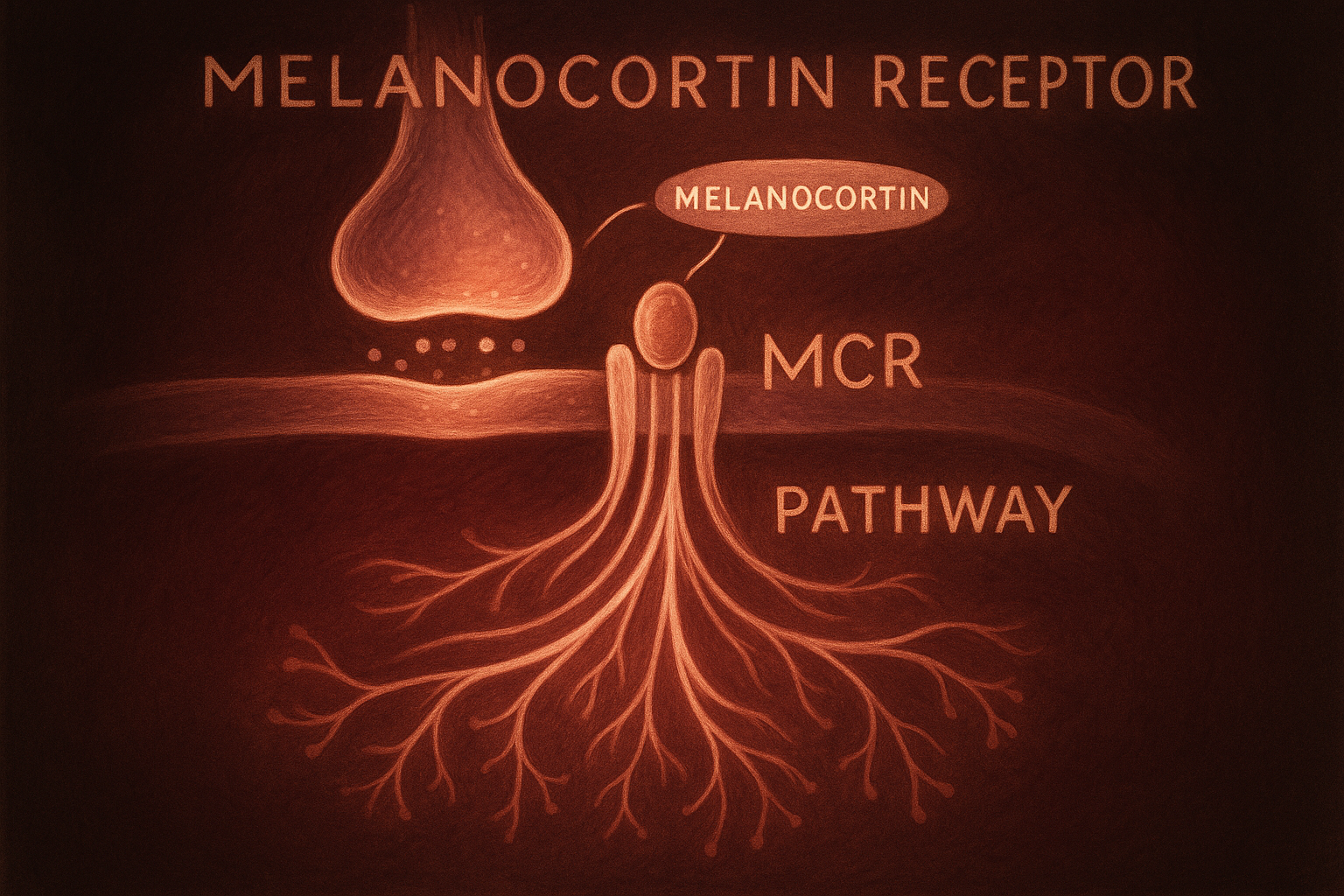
PT-141 is a melanocortin receptor agonist. It binds primarily to MC4R and to a lesser degree MC3R in the hypothalamus and limbic system. These receptors sit at the center of the brain's sexual arousal circuitry.
When PT-141 activates MC4R, it increases dopamine release in the medial preoptic area (a region critical to sexual motivation), activates hypothalamic pathways governing arousal, and modulates oxytocin signaling (Pfaus et al., 2004). It bypasses the vascular system entirely.
Desire vs. Arousal: Why the Brain Matters
Sexual response has two distinct components: desire (wanting) and arousal (physical readiness). PDE5 inhibitors like Viagra address arousal by increasing blood flow to erectile tissue. But if the desire isn't there, blood flow alone won't fix the problem.
PT-141 targets desire. That's why it works in populations where Viagra fails, particularly women with HSDD and men whose erectile dysfunction has a psychological or motivational component.
In animal models, PT-141 induced erections in male rats and lordosis behavior in female rats through central nervous system pathways, independent of peripheral blood flow changes (Martin et al., 2002).
The Broader Melanocortin System
The melanocortin system regulates far more than skin pigmentation. MC4R specifically is involved in sexual function, energy homeostasis, cardiovascular regulation, and pain modulation.
This is why PT-141 can cause side effects like nausea and blood pressure changes. It's activating a system with broad physiological reach.
FDA Approval: Vyleesi
On June 21, 2019, the FDA approved bremelanotide (Vyleesi) for the treatment of hypoactive sexual desire disorder (HSDD) in premenopausal women. It was only the second drug ever approved for this indication, following flibanserin (Addyi) in 2015.
| Approval Detail | Information |
|---|---|
| Date | June 21, 2019 |
| Indication | HSDD in premenopausal women |
| Manufacturer | AMAG Pharmaceuticals (licensed from Palatin Technologies) |
| Delivery | Single-dose autoinjector (1.75 mg) |
| Dosing | As needed, at least 45 min before activity |
| Max Frequency | Once per 24 hours, max 8 doses per month |
| Onset | 45 minutes to 2 hours |
| Duration | Up to 12 hours (varies by individual) |
The approval was based on two pivotal Phase 3 trials: RECONNECT-1 and RECONNECT-2.
Vyleesi is not approved for men, postmenopausal women, or erectile dysfunction. Off-label use exists, but clinical data in men is more limited.
Clinical Evidence
RECONNECT Trials (Women with HSDD)
The two Phase 3 RECONNECT trials enrolled over 1,200 premenopausal women diagnosed with HSDD. Both were randomized, double-blind, placebo-controlled studies lasting 24 weeks.
RECONNECT Results
Participants: 1,247 premenopausal women | Duration: 24 weeks | Dose: 1.75 mg subcutaneous, as needed | Primary Endpoints: Change in desire (FSFI-D) and distress (FSDS-DAO) scores
| Outcome | Bremelanotide | Placebo |
|---|---|---|
| Desire score (FSFI-D) | +0.57 | +0.21 |
| Distress score (FSDS-DAO) | –0.72 | –0.41 |
| Satisfying events (per month) | +0.7 | +0.4 |
| Responder rate (desire) | ~35% | ~22% |
The effect sizes were modest but statistically significant (Kingsberg et al., 2019). Critics noted the clinical relevance is debatable. Supporters pointed out that HSDD is notoriously difficult to treat and any measurable improvement in desire is meaningful.
Male Erectile Dysfunction Studies
PT-141 has been studied in men with erectile dysfunction in earlier-phase trials with encouraging results. A Phase 2 trial in men with ED who had failed to respond to sildenafil showed that PT-141 produced erections sufficient for intercourse in a significant percentage of participants.
| Parameter | Detail |
|---|---|
| Participants | 342 men with ED |
| Design | Randomized, placebo-controlled, dose-ranging |
| Dose range | 0.3 mg to 10 mg (intranasal) |
| Key finding | Significant erectile response at doses of 4 mg and above |
This was significant because these men had already failed on Viagra (Diamond et al., 2006). A separate study found dose-dependent increases in erectile function, including in men with diabetes-related ED (Rosen et al., 2004).
PT-141 may be particularly useful for psychogenic ED, where the problem originates in the brain rather than the vasculature. Since it works centrally, it addresses the psychological and motivational components that PDE5 inhibitors cannot. No large-scale trials have been completed for this specific indication, but the mechanism strongly supports its potential.
Dosing Protocols
These are based on FDA-approved labeling and clinical research protocols. Always work with a qualified provider.
FDA-Approved Dosing (Vyleesi)
| Parameter | Recommendation |
|---|---|
| Dose | 1.75 mg |
| Route | Subcutaneous injection (abdomen or thigh) |
| Timing | At least 45 minutes before anticipated activity |
| Max frequency | Once per 24 hours |
| Monthly limit | 8 doses per month |
| Onset | 45 minutes to 2 hours |
| Duration | Up to 12 hours (varies) |
Research Dosing (Off-Label / Men)
Dosing in male studies has varied. The following reflects protocols from clinical trials.
| Parameter | Detail |
|---|---|
| Dose range studied | 0.5 mg to 2 mg (subcutaneous) |
| Common research dose | 1 mg to 2 mg |
| Route | Subcutaneous injection |
| Timing | 30 to 60 minutes before activity |
Higher doses do not necessarily produce better results but do increase the likelihood of nausea and blood pressure elevation. More is not better with this peptide.
If using lyophilized powder (research setting), follow standard peptide reconstitution with bacteriostatic water. See our reconstitution guide for step-by-step instructions.
Side Effects and Safety
The side effect profile is well-characterized from the RECONNECT trials and other clinical studies. Nausea is by far the most common complaint.
Common Side Effects
| Side Effect | Frequency | Notes |
|---|---|---|
| Nausea | ~40% | Most common; usually mild to moderate, resolves within hours |
| Flushing | ~20% | Facial and upper body warmth and redness |
| Headache | ~11% | Typically mild |
| Injection site reactions | ~5–6% | Bruising, redness, itching at injection site |
| Blood pressure increase | Common | Typically 2–6 mmHg systolic; resolves within 12 hours |
Less Common
Mild Concerns
Fatigue following use. Dizziness in a small percentage of users. Nasal congestion (reported in intranasal formulation studies).
Serious Concerns
Hyperpigmentation with repeated use (darkening of skin, gums, or breasts). Persistent blood pressure elevation in those with cardiovascular risk factors.
PT-141 is contraindicated in patients with uncontrolled hypertension or cardiovascular disease due to its transient blood pressure effects. It should not be used alongside flibanserin (Addyi). It should not be used in pregnancy.
PT-141 vs. Viagra vs. Cialis
This is the comparison most people want. The three drugs could not be more different in how they work.
| Feature | PT-141 | Viagra (Sildenafil) | Cialis (Tadalafil) |
|---|---|---|---|
| Mechanism | MC receptor agonist (brain) | PDE5 inhibitor (blood vessels) | PDE5 inhibitor (blood vessels) |
| Primary target | Sexual desire + arousal | Erectile blood flow | Erectile blood flow |
| Works in women | Yes (FDA-approved) | Generally no | Generally no |
| Works in men | Yes (off-label) | Yes (FDA-approved) | Yes (FDA-approved) |
| Route | SC injection | Oral tablet | Oral tablet |
| Onset | 45 min to 2 hours | 30–60 min | 30–60 min |
| Duration | Up to 12 hours | 4–6 hours | Up to 36 hours |
| Addresses desire | Yes | No | No |
| Common side effects | Nausea, flushing | Headache, flushing, visual changes | Headache, back pain, flushing |
| BP effect | Slight increase | Decrease | Decrease |
When PT-141 May Be Better
Low desire is the primary issue. PDE5 inhibitors haven't worked. Female sexual dysfunction. Psychological or motivational ED where the brain is the bottleneck.
When PDE5 Inhibitors Are Better
Vascular ED with clear blood flow limitation. Preference for oral dosing. Well-established safety profile with decades of data. Cost and accessibility (generics widely available).
PT-141 and PDE5 inhibitors solve different problems. One addresses want. The other addresses can. Some people need both.
PT-141 vs. Flibanserin (Addyi)
Since both are FDA-approved for HSDD in premenopausal women, this comparison comes up frequently.
| Feature | PT-141 (Vyleesi) | Flibanserin (Addyi) |
|---|---|---|
| Dosing | As needed (injection) | Daily (oral pill, 100 mg at bedtime) |
| Onset | 45 min to 2 hours | 4–8 weeks of daily use |
| Mechanism | MC4R agonist | 5-HT1A agonist / 5-HT2A antagonist |
| Alcohol restriction | None | Severe (risk of hypotension and syncope) |
| Common side effects | Nausea, flushing | Dizziness, sleepiness, nausea |
| REMS program | No | Yes (due to alcohol interaction) |
| Convenience | As-needed, no daily commitment | Must take every night for weeks |
PT-141 has a clear advantage for women who don't want a daily medication or who drink alcohol. Flibanserin's alcohol restriction and mandatory REMS certification for prescribers have significantly limited its adoption.
Who Might Benefit
Based on clinical data and the mechanism of action, PT-141 may be appropriate for several populations.
Premenopausal Women with HSDD
The only FDA-approved indication. Supported by two pivotal Phase 3 trials with over 1,200 participants.
Men with ED Unresponsive to PDE5 Inhibitors
Phase 2 data supports efficacy in men who failed sildenafil. Many men's health clinics prescribe it off-label.
Men with Psychogenic ED
Where desire or arousal initiation is the core issue. The central mechanism directly addresses motivational components.
Desire Discrepancy Cases
Couples where desire discrepancy is the problem rather than physical function. Can be combined with PDE5 inhibitors under medical supervision.
Legal Status and Availability
United States
FDA-approved as Vyleesi (prescription only). Also available as research peptide. Autoinjector costs approximately $800–$1,000 for a pack of four.
European Union
Not approved. Available through research chemical suppliers.
Australia
Not TGA-approved. Available through compounding pharmacies in some cases.
Canada
Not approved by Health Canada.
Research-grade PT-141 is available from peptide suppliers at significantly lower cost, though without the quality assurance of pharmaceutical manufacturing. Check our peptide legality guide for full details.
Frequently Asked Questions
What does PT-141 actually feel like?
How long does PT-141 last?
Can men use PT-141?
Is PT-141 the same as Melanotan II?
Can you combine PT-141 with Viagra or Cialis?
Does PT-141 work for everyone?
Are there long-term risks?
Why is PT-141 an injection and not a pill?
The Bottom Line
PT-141 is the only approved treatment that works through the brain's melanocortin system to increase desire rather than simply improving blood flow. For the right patient, it fills a gap that no other drug currently addresses.
For women with HSDD, it offers an as-needed alternative to daily flibanserin without alcohol restrictions. For men, the off-label evidence suggests real utility, especially in cases where PDE5 inhibitors have failed or where the problem is motivational rather than vascular.
The trade-offs are real. Nausea affects a large percentage of users. It requires injection rather than a pill. And the effect sizes in clinical trials, while statistically significant, were modest. Not everyone responds.
But for the right patient, PT-141 fills a gap that no other drug currently addresses. It treats the wanting, not just the doing.
This article is for educational and informational purposes only and does not constitute medical advice. PT-141 (bremelanotide) is an FDA-approved prescription medication (Vyleesi) that should only be used under the guidance of a qualified healthcare provider. Do not self-treat. Always discuss potential risks, side effects, and drug interactions with your doctor before starting any peptide protocol.
References
Pfaus JG et al. Selective facilitation of sexual solicitation in the female rat by a melanocortin receptor agonist. Proc Natl Acad Sci USA. 2004;101(27):10201-4. PubMed
Martin WJ et al. Pharmacological profile of a melanocortin receptor agonist on penile erection. Eur J Pharmacol. 2002;454(1):71-9. PubMed
Kingsberg SA et al. Bremelanotide for the Treatment of Hypoactive Sexual Desire Disorder: Two Randomized Phase 3 Trials. Obstet Gynecol. 2019;134(5):899-908. PubMed
Diamond LE et al. An effect on the subjective sexual response in premenopausal women with sexual arousal disorder by bremelanotide (PT-141), a melanocortin receptor agonist. J Sex Med. 2006;3(4):628-38. PubMed
Rosen RC et al. Bremelanotide (PT-141): a melanocortin receptor agonist for the treatment of erectile dysfunction. Int J Impot Res. 2004;16(Suppl 1):S8-S13. PubMed
Related reading:
What Are Peptides? Beginner's Guide · Melanotan II Complete Guide · Peptide Side Effects: What to Know · Are Peptides Legal? FDA Regulations 2026
For compound profiles and sourcing info, visit PeptideArc.