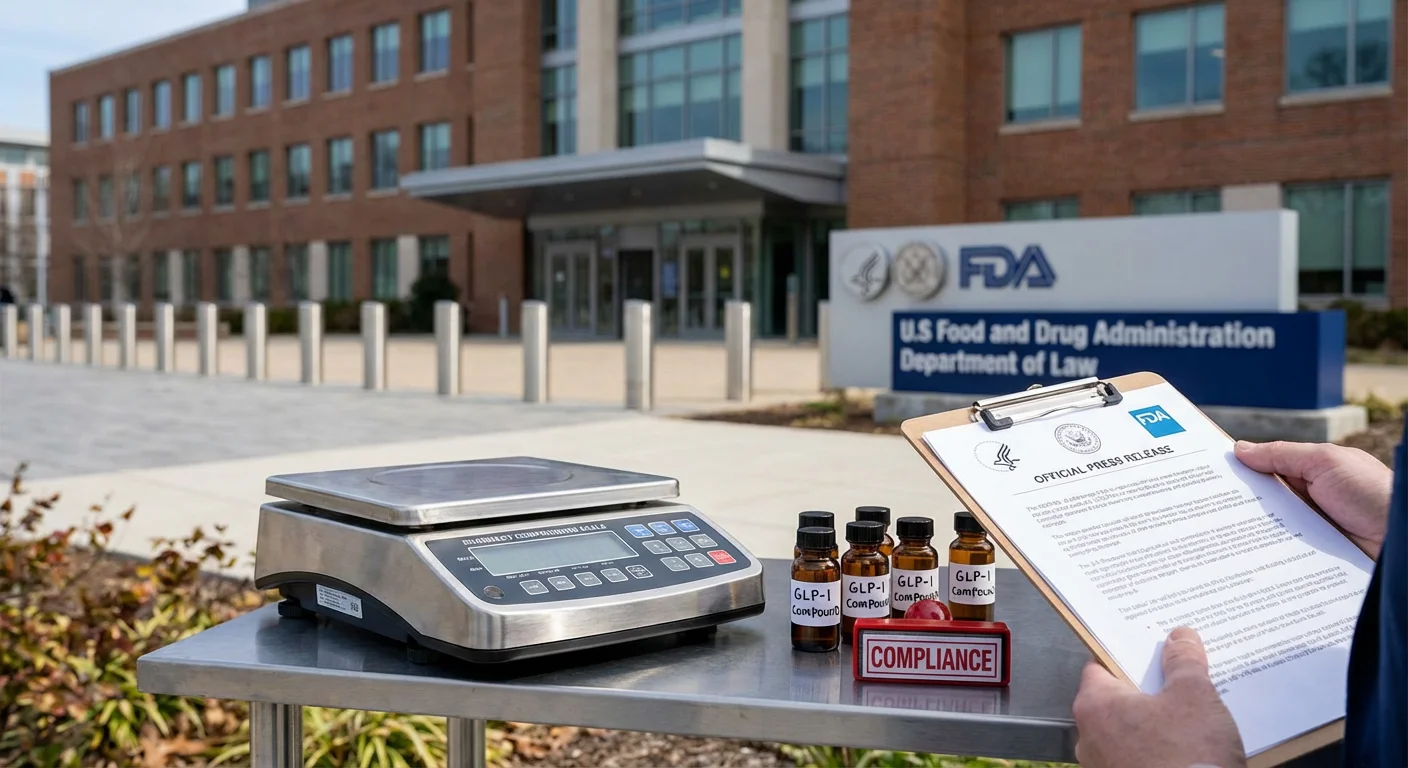
FDA signals tougher action on mass-marketed compounded GLP-1s
A new FDA statement (Feb 6, 2026) targets non-approved GLP-1 compounded products and the marketing claims around them, raising the compliance stakes for clinics and compounders.
The FDA is turning up the heat on companies mass-marketing compounded GLP-1 products.
In a February 6, 2026 statement, FDA Commissioner Martin A. Makary said the agency intends to restrict GLP-1 active pharmaceutical ingredients intended for use in non-FDA-approved compounded drugs and to pursue misleading direct-to-consumer marketing.
That matters because GLP-1s sit at the crossroads of real medicine and the online gray market.
They are peptide-based therapies with strong clinical evidence when prescribed and manufactured correctly.
They are also being copied, diluted, reformulated, and marketed in ways that blur the line between legitimate compounding and large-scale alternative supply chains.
Source:
- FDA statement (Feb 6, 2026): https://www.fda.gov/news-events/press-announcements/fda-intends-take-action-against-non-fda-approved-glp-1-drugs
What the FDA actually said
The statement is not subtle.
The FDA says it will take “decisive steps” to restrict GLP-1 APIs used in non-approved compounded products that are being mass-marketed as “similar alternatives” to FDA-approved drugs.
It also calls out a specific marketing pattern: companies claiming their compounded products are generic versions, the same as FDA-approved drugs, or “clinically proven.”
Those claims are a problem because compounded drugs are not FDA-approved.
Compounding exists to meet patient-specific clinical needs, not to create a parallel consumer brand that shadows a blockbuster drug.
Why this is happening now
For the past couple of years, demand and shortages created space for aggressive compounding and aggressive marketing.
As shortages ease, the logic changes.
The more stable the commercial supply becomes, the harder it is to justify wide distribution of compounded copies that look and feel like retail products.
That is where this statement lands.
It reads like a warning shot aimed at scale.
The compliance ripple effect for clinics
This is not just a “big telehealth company” story.
If you are a physician-owned clinic, medspa, or wellness practice that offers GLP-1s, you should read the FDA statement as a message about risk.
Here are a few areas where the pressure is likely to show up.
- Marketing language: Phrases like “same active ingredient” and “generic Ozempic” are now clearly in the agency’s sights.
- Supply chain questions: Where the API came from, and how it was handled, is likely to matter more.
- Indication creep: Longevity, cognitive support, and “microdosing” narratives are easy to sell and hard to defend.
MIT Technology Review’s recent explainer on the broader peptide boom notes that enforcement has been inconsistent, in part because online sellers can pop up quickly.
But it also points out the enforcement tools are real, including warning letters, seizures, and injunctions.
Source:
- MIT Technology Review (Feb 23, 2026): https://www.technologyreview.com/2026/02/23/1133522/peptides-are-everywhere-heres-what-you-need-to-know/
A parallel crackdown: unapproved “wellness peptides”
The GLP-1 story is happening alongside a wider tightening around unapproved peptides.
A February 2026 risk and compliance write-up by physician Yoon Hang Kim describes growing state-level enforcement pressure, including scrutiny of peptides labeled “research use only” that are being administered in clinics.
It also claims that several commonly marketed peptides have been placed into FDA Category 2 (substances with safety concerns) for 503A bulk drug substances.
Source:
- Yoon Hang Kim (Feb 2026): https://www.yoonhangkim.com/post/peptides-in-clinical-practice-feb-2026-risk-analysis-and-compliance-framework-for-physician-ownersf
We are not endorsing every claim in that post.
But the direction of travel lines up with what the FDA is saying out loud: the era of casual, mass-marketed compounding is ending.
What this means for patients
For patients, this is another reminder that “compounded” does not automatically mean “unsafe.”
It also does not automatically mean “equivalent.”
If you are considering compounded GLP-1s, basic questions are reasonable:
- Who prescribed it, and what follow-up is built in?
- Which pharmacy prepared it, and how is quality documented?
- What, exactly, is in the vial, and in what concentration?
- Are the marketing claims clear about approval status?
GLP-1 therapy can be life-changing.
But only when the product is real, the dosing makes sense, and the supervision is serious.