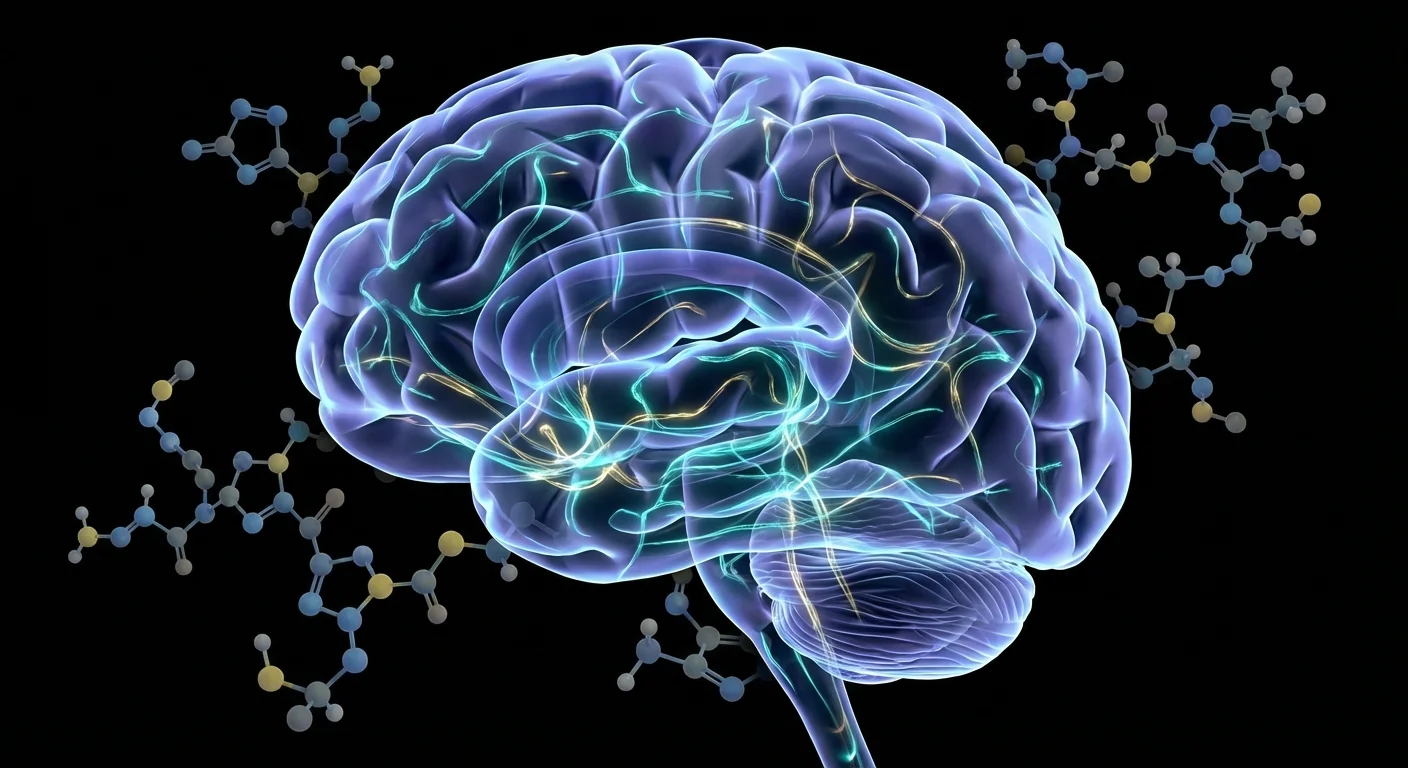
GLP-1 Peptides Are Being Studied for Brain Protection — And the Data Is Getting Harder to Ignore
New analysis finds GLP-1 receptor agonists show neuroprotective effects in Alzheimer's, Parkinson's, and traumatic brain injury models. The brain connection was always there — researchers are finally taking it seriously.
Everyone knows GLP-1 drugs for weight loss. That’s the headline story, and it’s been running for three years. But there’s a parallel story that’s been building in neuroscience journals, and it’s starting to get the attention it deserves.
GLP-1 receptor agonists — semaglutide, liraglutide, and their cousins — appear to have meaningful neuroprotective effects. Not theoretical ones. Animal models, observational human data, and early clinical signals are all pointing in the same direction. This week, NeurologyLive published a review repositioning these drugs as genuine candidates for neurological disease treatment, and it’s worth understanding why.
GLP-1 Receptors Are All Over the Brain
The neuroprotection hypothesis starts with basic biology.
GLP-1 receptors aren’t only in the pancreas and gut. They’re distributed throughout the central nervous system — in the hippocampus, hypothalamus, brainstem, and cortex. That distribution was documented as early as 2002, but its implications weren’t widely appreciated until researchers noticed that GLP-1 drugs could cross the blood-brain barrier.
Once you establish that these peptides can reach the brain, the question becomes what they do there. The answer, from animal studies: quite a lot.
GLP-1 agonists reduce neuroinflammation by suppressing microglial activation. They appear to protect neurons from oxidative stress. They promote neurogenesis (growth of new neurons) in the hippocampus. And they reduce the accumulation of amyloid and tau proteins that are hallmarks of Alzheimer’s disease.
📊 Research highlights from recent reviews:
- Liraglutide reduced amyloid plaque burden in Alzheimer’s mouse models in multiple independent studies
- Semaglutide showed neuroprotective effects in Parkinson’s disease models, reducing dopaminergic neuron loss
- GLP-1 agonists lowered inflammatory cytokine levels in brain tissue after injury
- Human epidemiological data suggests lower dementia rates in diabetic patients treated with GLP-1 drugs vs. other antidiabetics
The Parkinson’s Signal Deserves Special Attention
Of all the neurological conditions where GLP-1 drugs are being studied, Parkinson’s disease has the most developed clinical evidence.
A randomized controlled trial of semaglutide in Parkinson’s patients was announced in 2024, following earlier promising data from a liraglutide trial showing slowed motor decline. The mechanism makes biological sense: GLP-1 receptors are expressed on dopaminergic neurons in the substantia nigra, the area of the brain that Parkinson’s progressively destroys.
This isn’t someone speculating. The research path from receptor expression to animal model to human signal exists. And the fact that millions of people are now taking GLP-1 drugs creates a natural observational dataset that epidemiologists are actively mining.
It’s still early. Correlation in epidemiological data isn’t causation, and animal models frequently fail to translate. But the convergence of mechanism, animal data, and epidemiological signal is the kind of pattern that attracts serious research funding.
Traumatic Brain Injury: A Different Angle
Separately, research on small neuroprotective peptides has been moving quickly. A December 2025 study from ScienceDaily highlighted a four-amino-acid peptide called CAQK that showed powerful brain-protective effects in traumatic brain injury models.
Delivered via standard IV, CAQK zeroed in on injured brain tissue, calmed inflammation, and reduced cell death in the damaged area. The targeting specificity was notable — it didn’t diffuse broadly, it concentrated at the injury site.
This is a different mechanism than GLP-1 drugs, but it underscores the same broader point: peptides are increasingly where serious neurological research is happening. The field has shifted from small molecules toward biologics and peptides, because the targeting precision and safety profiles are often better.
What This Means for Patients Today
Right now: not much, practically speaking. GLP-1 drugs are approved for diabetes and weight management, not neurological conditions. Prescribing them specifically for Alzheimer’s prevention or Parkinson’s treatment would be off-label, and off-label prescribing for unproven indications carries real risks, including insurance non-coverage.
But the research pipeline is active. Several clinical trials are underway specifically examining GLP-1 drugs in neurological contexts. If even one returns positive Phase 3 data, the FDA approval pathway opens, and prescribing patterns shift dramatically.
💡 The longer-term picture: GLP-1 drugs that started as diabetes medications, then became weight loss drugs, may end up being the first class of compounds shown to genuinely modify Alzheimer’s or Parkinson’s disease progression. That would be one of the most significant developments in medicine in decades.
Why This Matters Beyond Headlines
The peptide-brain connection isn’t new. Peptide signaling in the nervous system is fundamental biology — neuropeptides are how neurons talk to each other. What’s new is that a class of drugs originally designed to mimic gut hormones is showing up, credibly, in neurodegeneration research.
That’s partly an accident of discovery. It’s also a reminder that we don’t fully understand what most peptides do when they reach the brain. The therapeutic space that creates is enormous.
GLP-1 drugs are already the biggest pharmaceutical story of the decade. If the neurological data holds up, they become something else entirely: a first-generation disease-modifying therapy for conditions that have had essentially no meaningful treatment options for the past forty years.
That’s worth watching closely.
This article discusses emerging research and does not constitute medical advice. GLP-1 receptor agonists should only be used under the supervision of a licensed healthcare provider.