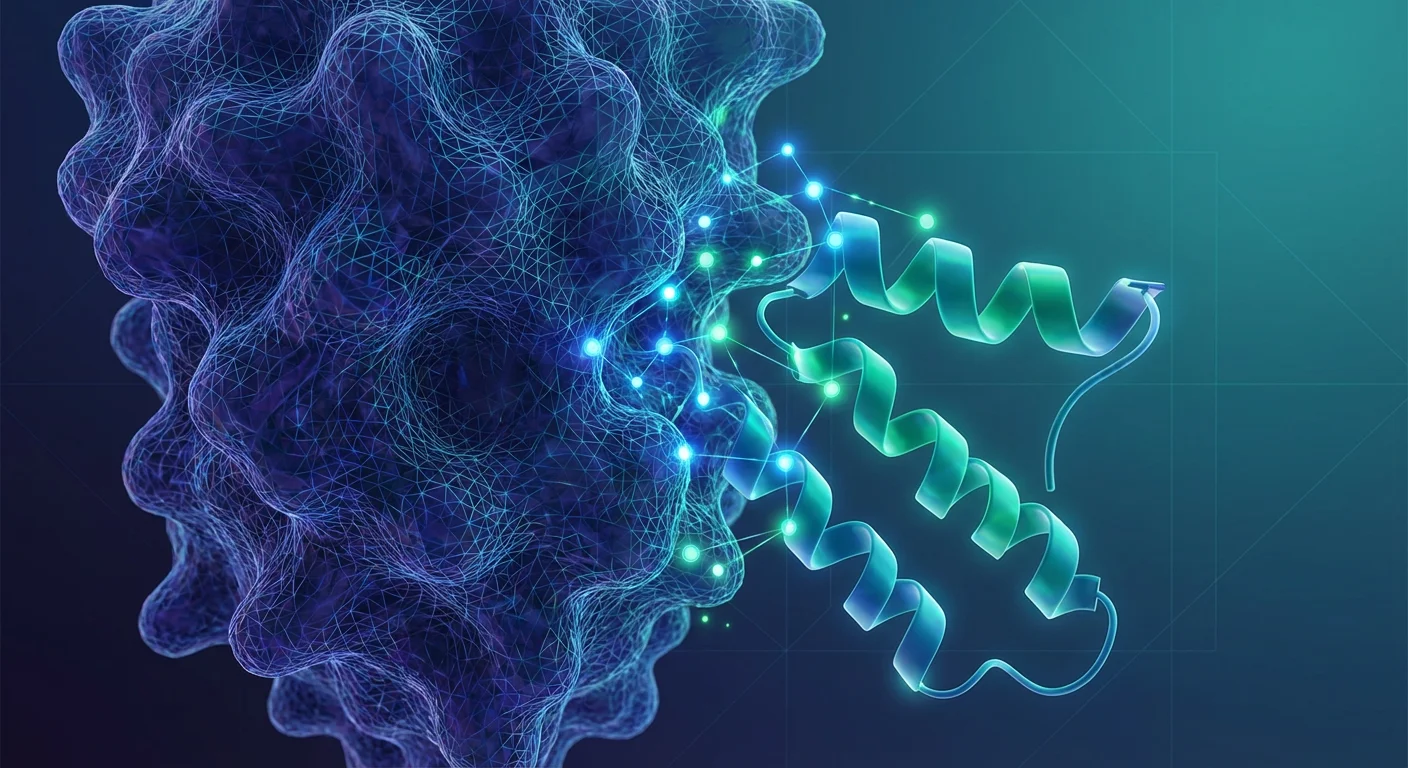
New 2026 Review Maps the Peptide-Protein Docking Toolchain (and Why It Matters for Therapeutics)
A new Journal of Computational Chemistry review catalogs peptide-protein docking software and AI alternatives, offering a practical snapshot of what works, what breaks, and where the field is headed.
Most peptide news is about injections, regulation, or another new GLP-1. But a lot of the future of peptide therapeutics is being decided earlier than that, in modeling and simulation pipelines that pick which sequences are worth making in the first place.
A new 2026 review in the Journal of Computational Chemistry tries to do something refreshingly unglamorous: it rounds up peptide-protein docking tools, compares them, and explains where they still fail.
The paper is: Fábio G. Martins et al., “A Review of Current Computational Tools for Peptide-Protein Docking.” PubMed: https://pubmed.ncbi.nlm.nih.gov/41685658/ (full text also available via PubMed Central).
Docking peptides is not docking small molecules
If you have done any structure-based drug design, you already know the basic promise of docking: take a target protein, take a ligand, and predict how they bind.
Peptides make that simple story messy.
A peptide is flexible. Side chains can swing, backbones can adopt many conformations, and the peptide can bind in more than one plausible pose. Some peptides stay disordered until they touch the target.
That means a docking program needs to search a much larger space. And it has to score that space in a way that does not reward nonsense.
The review frames peptide-protein docking as both a method problem and a workflow problem. The tooling is not only about the docking engine itself. It is also about how you set up the peptide, how you represent flexibility, and whether you follow docking with refinement (like molecular dynamics).
What the review actually provides
Martins and colleagues report identifying 14 dedicated peptide-protein docking programs, plus small-molecule docking tools that can be adapted for peptides. They also discuss AI-driven alternatives.
Even if you never plan to run these tools, the list is useful because it reveals how fragmented the field still is. There is no single “default” solution that everyone agrees on.
The paper’s keyword list tells you what the authors think this connects to:
- drug discovery
- molecular docking and modeling
- peptide therapeutics
- structure-based design
That is the throughline. This is not docking as a hobby. It is docking as a filter in the early therapeutic pipeline.
A practical takeaway: workflow beats magic software
One of the more honest parts of the docking conversation is this: people often ask, “What tool should I use?”
A better question is, “What is my peptide doing?”
If your peptide is short and constrained, the search problem is different than if your peptide is long and floppy. If the target protein has a known binding groove and a reference ligand, you can use that information. If you have no idea where the peptide binds, your challenge starts earlier.
The review highlights strengths and limitations across tools. The field is full of tradeoffs:
- Faster search vs better sampling
- Rigid receptor vs flexible receptor modeling
- Simple scoring vs more physics-based refinement
- Accessibility (web servers) vs control (local pipelines)
And in many projects, the best results come from chaining steps together: coarse docking to generate candidates, then refinement to check stability.
AI is helping, but it is not a free pass
The review also discusses AI-driven alternatives. That is the part that will draw the most attention in 2026, because “AI for structure” is now mainstream.
But the same core challenge remains. If your model cannot represent peptide flexibility and protein rearrangements realistically, you can still get a confident-looking wrong answer.
AI can reduce the search burden and learn patterns from data. It can also amplify bias in the data it has seen.
So the interesting question is not “AI or not.” It is whether AI tools are being used to generate better candidates that then survive downstream validation.
Why peptide readers should care
Most people reading PeptideRundown are not writing docking code. But computational tooling shapes what ends up in the clinic, what ends up in gray markets, and what becomes the next wave of “hot” sequences.
If docking tools get better, you should expect:
- faster peptide lead discovery
- more niche peptides targeting protein-protein interactions
- more rational sequence tweaks instead of trial-and-error tinkering
And if the tools stay unreliable, you should expect more noise. That noise eventually reaches consumers as overconfident claims.
A grounded review like this is a good counterweight.
It does not promise miracles. It catalogs reality, including the parts that are still hard.