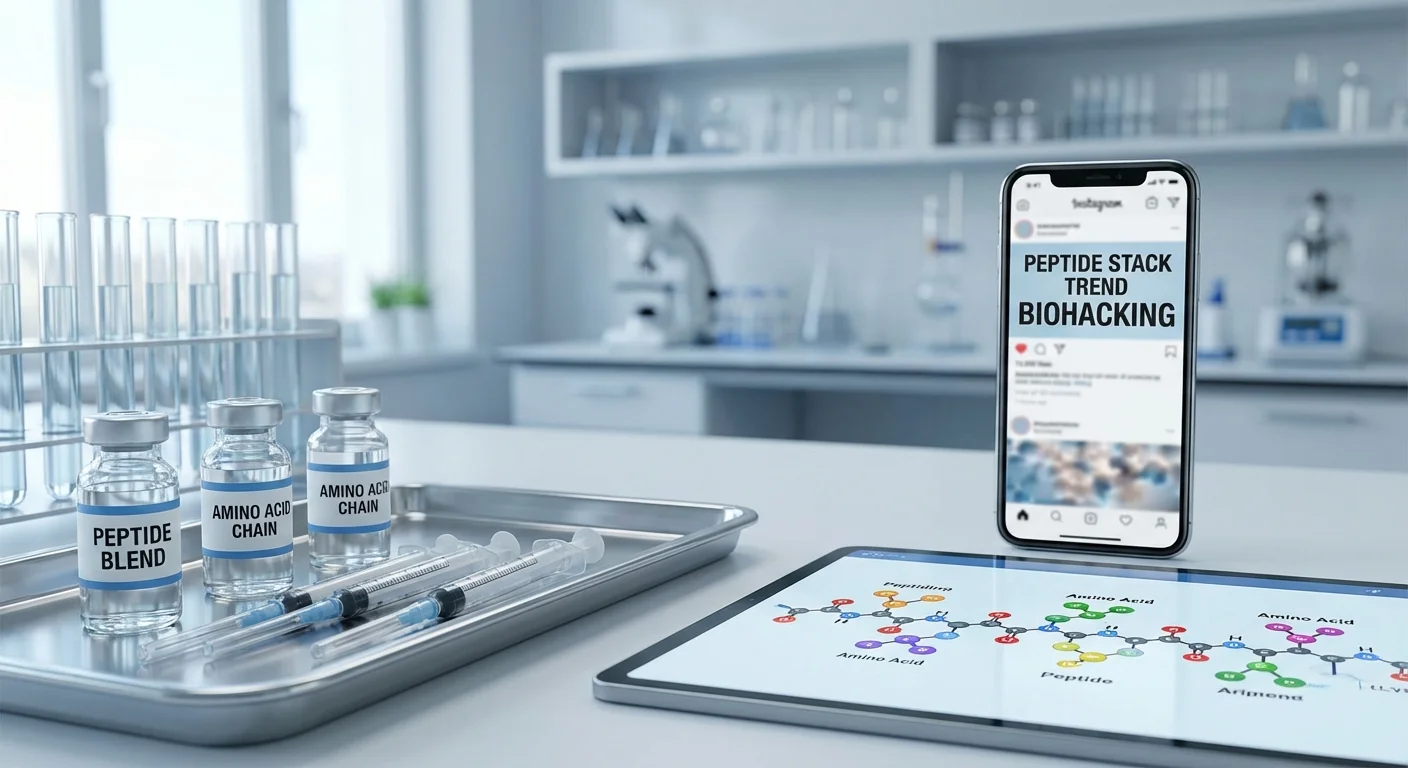
Peptides are everywhere, but the evidence is uneven
Mainstream outlets are finally covering the peptide boom. Here’s what they’re getting right, what they’re missing, and why quality and clinical data matter more than hype.
Peptides have fully crossed over from niche biohacker forums to mainstream conversation.
This week’s coverage from MIT Technology Review and NPR basically says the same thing in different voices: yes, peptides are real biology, and yes, a lot of what’s being sold online is way ahead of the human data.
That framing is mostly fair.
But there’s a detail that gets lost when people talk about “peptides” like it’s one category: the gap between FDA-approved peptide drugs (think insulin, GLP-1 meds) and gray-market “research” vials is enormous.
What the media is getting right
Both pieces highlight two risks that keep showing up in the real world.
First, many popular wellness peptides have little to no controlled human evidence for the use cases people claim.
Second, quality is a serious problem when you buy peptides “for research use only” and then use them anyway.
MIT Technology Review points to third-party testing that found purity and potency vary across vendors, and that some vials sold under a peptide name did not contain the compound at all.
NPR, meanwhile, emphasizes a simpler point: when dosing and safety data do not exist, people end up guessing.
That is not “personalized medicine.” It is improvisation.
Sources:
- MIT Technology Review (Feb 23, 2026): https://www.technologyreview.com/2026/02/23/1133522/peptides-are-everywhere-heres-what-you-need-to-know/
- NPR (Feb 23, 2026): https://www.npr.org/2026/02/23/nx-s1-5716162/peptides-science-muscle-growth-longevity-wellness
A quick reality check on the big names
If you’ve spent any time around peptide content, you’ve probably seen the same short list.
BPC-157. TB-500. CJC-1295 plus ipamorelin. GHK-Cu.
A useful way to think about them is: what’s in humans, what’s in animals, and what’s mostly marketing?
A 2026 narrative review in the American Journal of Sports Medicine lays it out bluntly for orthopedics and sports medicine: several of these compounds have interesting preclinical findings, but there is a lack of clinical evidence, and basic questions like dose, frequency, and duration are still not answered.
PubMed: “Injectable Peptide Therapy: A Primer for Orthopaedic and Sports Medicine Physicians” (PMID: 41476424)
https://pubmed.ncbi.nlm.nih.gov/41476424/
For BPC-157, a 2025 systematic review found 36 included studies, with 35 preclinical and 1 clinical study. The authors note encouraging animal data for musculoskeletal healing, but also highlight the absence of clinical safety data.
PubMed: “Emerging Use of BPC-157 in Orthopaedic Sports Medicine: A Systematic Review” (PMID: 40756949)
https://pubmed.ncbi.nlm.nih.gov/40756949/
None of this proves that BPC-157 “doesn’t work.” It says the internet is selling certainty where the literature still has big holes.
The part people skip: manufacturing quality and sterility
Even if a peptide turns out to be effective one day, that does not automatically make today’s marketplace safe.
The same sequence of amino acids can be made well or poorly.
And injectable products have to clear a much higher bar than powders and capsules. Sterility, endotoxins, and contaminants are not academic concerns.
They are the difference between “nothing happens” and “you end up in the hospital.”
If you are wondering why legitimate drug development is slow and expensive, this is part of the answer.
What to do if you’re trying to be a sane adult about peptides
A few practical rules help cut through the noise.
- Separate FDA-approved peptide drugs from unapproved “wellness” peptides. The evidence and the oversight are not comparable.
- Treat “research use only” labeling as a risk signal, not a loophole.
- When someone sells a “stack,” ask what problem it is solving, what data supports it, and how side effects are monitored.
- If the claim is “healed my injury in two weeks,” look for human trials, not highlight reels.
And if you want a simple filter: if nobody can point to controlled human data, you are in experiment territory.
Some people are comfortable with that.
But they should know what they are signing up for.