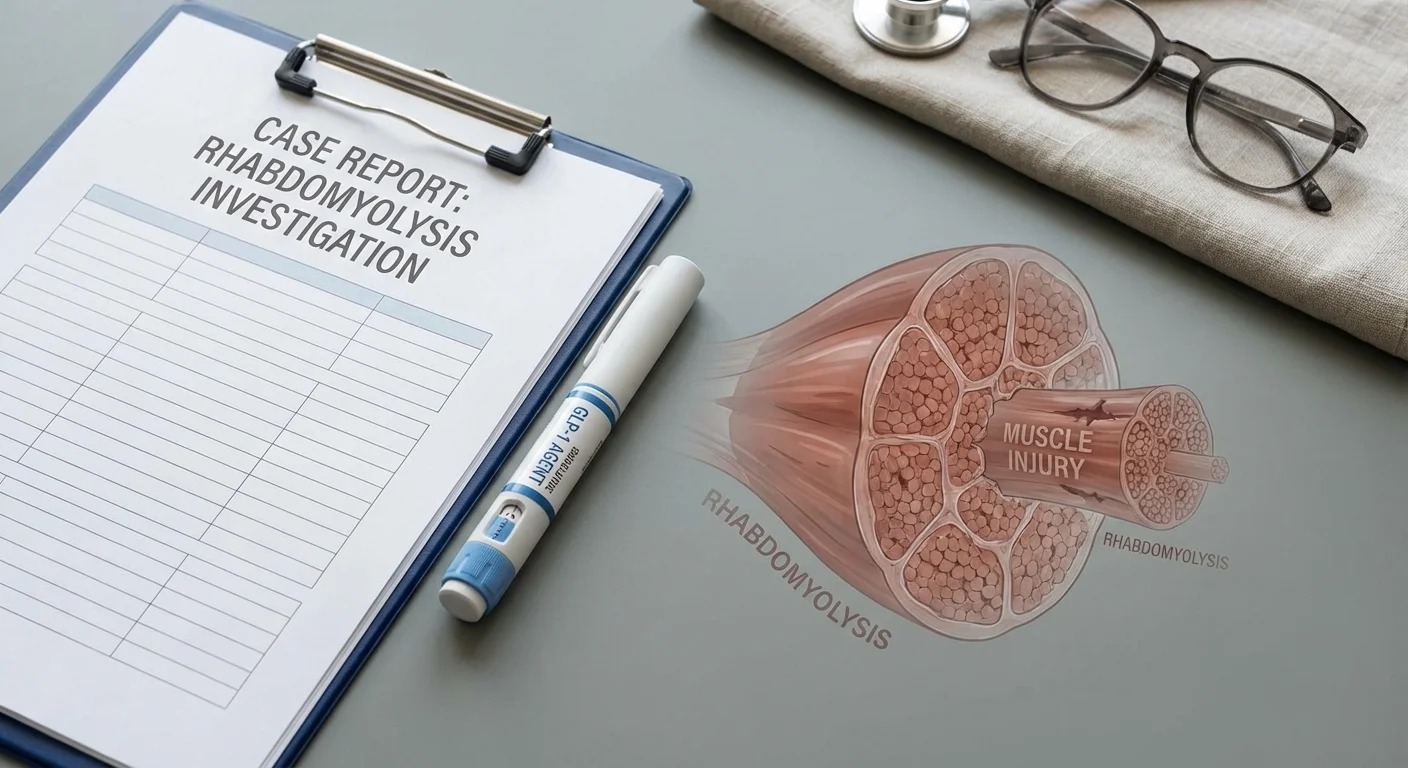
Rare but serious: a new case report describes probable tirzepatide-associated rhabdomyolysis
A Feb 23 case report describes rhabdomyolysis symptoms emerging after starting tirzepatide for weight loss, with improvement after stopping the drug and receiving IV fluids.
GLP-1 and GIP/GLP-1 drugs are now mainstream. That also means we are going to see the full spectrum of rare adverse events show up in the literature.
This week, a case report published Feb 23, 2026 describes a patient who developed rhabdomyolysis after starting tirzepatide.
It is not a reason for panic. But it is a useful reminder of what “rare” can look like when millions of people start the same medication.
Source case report (PubMed): https://pubmed.ncbi.nlm.nih.gov/41756106/
What happened in the case
The report describes a 34-year-old male with a history of HIV, hypertension, and obesity.
He presented with:
- Fatigue
- Muscle aches
- Dark-colored urine
Symptoms worsened over about two weeks, and the timing overlapped with starting tirzepatide for weight loss.
The workup showed:
- Markedly elevated creatine kinase (CK)
- Transaminitis
- Myoglobinuria
That combination supports the diagnosis of rhabdomyolysis.
The patient reported no trauma, no strenuous exercise trigger, and no statin use. Tirzepatide was stopped and he was treated with aggressive IV fluids. He was discharged in stable condition.
The authors frame it as the first probable case of tirzepatide-associated rhabdomyolysis in an HIV-positive patient.
What rhabdomyolysis is (quick refresher)
Rhabdomyolysis is muscle breakdown that releases intracellular contents into the bloodstream.
In severe cases, it can lead to kidney injury.
Classic warning signs include muscle pain, weakness, and dark urine, but presentations can be vague. That is part of why case reports matter.
How strong is the evidence here?
Case reports sit low on the evidence hierarchy. They do not prove causality.
Still, they can be the first signal of a pattern, especially for rare events that are unlikely to be captured in pre-approval trials.
In this report, the main features supporting a drug association are:
- The temporal relationship: symptoms followed initiation
- Lack of obvious triggers in the history
- Clinical improvement after discontinuation and supportive care
There are also reasons to be cautious.
-
HIV-positive patients may have different baseline risk factors for muscle disorders.
-
Case reports rely on what is reported and what is ruled out, and that is never perfect.
The right conclusion is not “tirzepatide causes rhabdo.”
The right conclusion is “rhabdo should be on the differential if a patient on tirzepatide presents with muscle pain, weakness, or dark urine.”
A wider context: pharmacovigilance data is pointing at muscle-related signals
Separately, a Feb 27, 2026 pharmacovigilance study analyzed FAERS reports for musculoskeletal adverse events across incretin-based diabetes drugs.
Source study (PubMed): https://pubmed.ncbi.nlm.nih.gov/41748946/
The authors report that, at the preferred-term level:
- GLP-1 receptor agonists were linked to signals like back pain and myalgia
- Tirzepatide was associated with signals including muscle atrophy and “neck mass”
They also found that median time to onset was shorter for GLP-1 receptor agonists and tirzepatide (≤ 30 days) compared with DPP-4 inhibitors.
FAERS data has major limitations. It is voluntary reporting and subject to bias.
But when a case report and a pharmacovigilance signal point in a similar direction, it is worth paying attention.
Practical takeaways
If you are on tirzepatide or prescribing it, the key is awareness, not fear.
-
New or severe muscle pain that feels out of proportion should be taken seriously.
-
Dark urine is a red flag that deserves prompt evaluation.
-
The first month matters. That is where some early-onset adverse events cluster.
And for clinicians, the paper’s closing line is the most useful.
Be vigilant for rhabdomyolysis in patients with nonspecific symptoms like muscle pain, fatigue, and dark urine who are using tirzepatide or other GLP-1 agents.
That is not sensational. It is just good medicine.