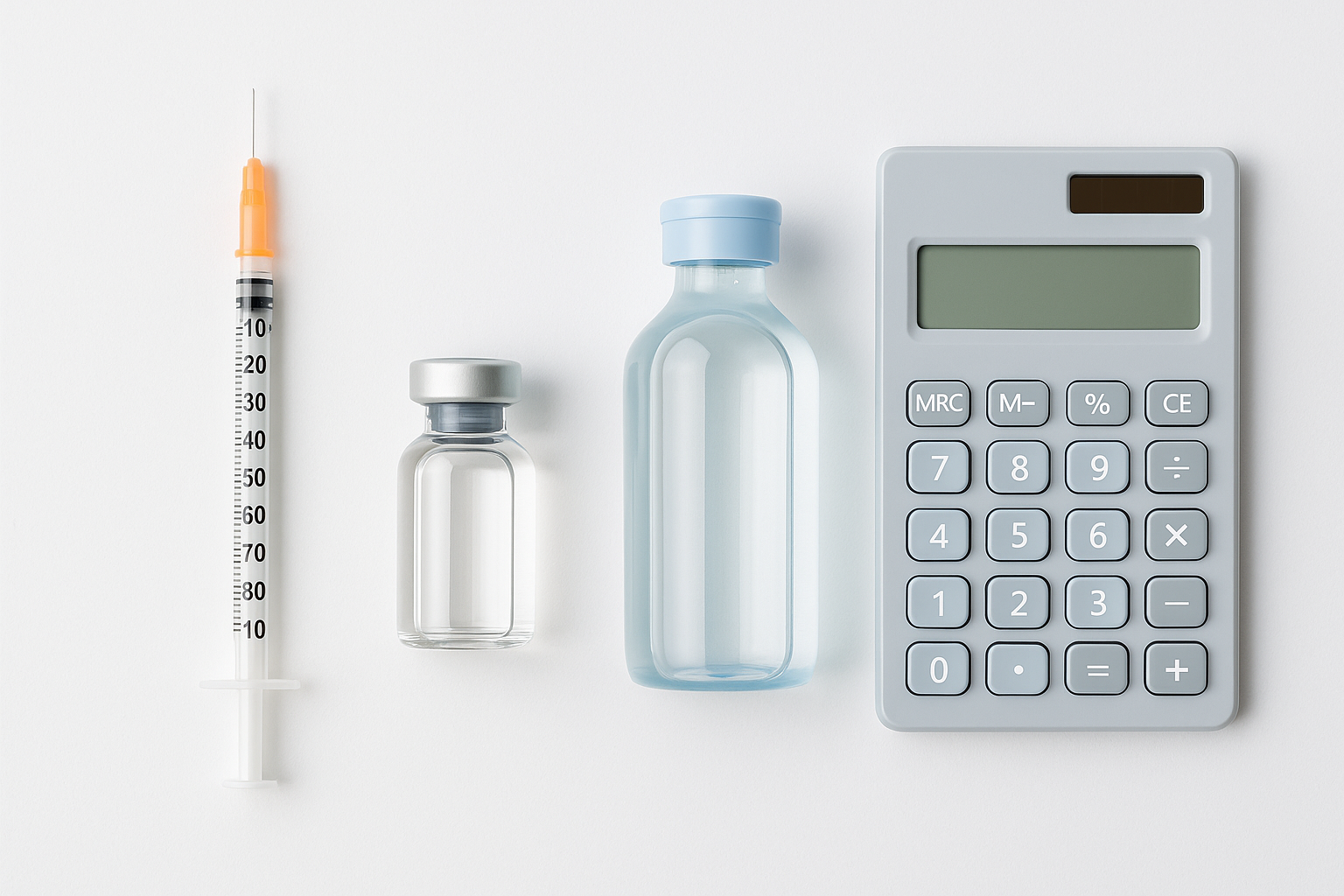
Peptide Dosing Calculator: Reconstitution Math Made Simple
The formulas, worked examples, and syringe-reading skills you need to calculate any peptide dose accurately. No guesswork, no apps required.
You Need
Type
Included
Conversion
Peptide dosing math trips up almost everyone at first. You are staring at a tiny vial of freeze-dried powder, an insulin syringe with cryptic markings, and instructions that say "inject 250 mcg." Bridging the gap between those three things is straightforward once you understand two formulas.
This guide walks through both formulas step by step, then applies them to six popular peptides so you can see the math in action. Bookmark it and come back whenever you reconstitute a new vial.
This is an educational reference for understanding peptide reconstitution math and syringe measurement. It is not a recommendation to use any peptide. Always consult a qualified healthcare provider before starting any peptide protocol.
Understanding Peptide Vials and Diluents
Peptides arrive as lyophilized (freeze-dried) powder sealed inside small glass vials. You cannot inject powder. You need to dissolve it in a liquid first, and the liquid you choose matters.
Bacteriostatic water (BAC water) is the standard choice for multi-dose vials. It contains 0.9% benzyl alcohol, which prevents bacterial growth over the days or weeks you draw from the same vial. Plain sterile water lacks this preservative and should only be used for single-dose immediate injections.
Always use bacteriostatic water for any vial you plan to draw from more than once. Sterile water without preservative becomes a contamination risk after the first needle puncture.
Common vial sizes are 2 mg, 5 mg, and 10 mg. The amount of water you add determines the concentration, and concentration determines how much liquid you draw for each dose. More water means a more dilute solution and larger, easier-to-measure volumes.
Bacteriostatic Water
Contains: 0.9% benzyl alcohol | Use for: Multi-dose vials | Shelf life once opened: 28 days | Storage: Room temperature or refrigerated
Sterile Water
Contains: No preservatives | Use for: Single immediate injection only | Shelf life once opened: Use immediately | Storage: Room temperature
The Two Formulas You Need
Every peptide dose calculation comes down to two steps. First you find the concentration. Then you find the injection volume. That is it.
Concentration = Peptide (mg) / Water (mL)
This tells you how many milligrams of peptide are dissolved in each milliliter of liquid. A 5 mg vial reconstituted with 2 mL of BAC water gives a concentration of 2.5 mg/mL. Simple division.
Dose Volume (mL) = Desired Dose (mg) / Concentration (mg/mL)
Once you know the concentration, divide your target dose by it to find the volume you need to draw. Then multiply by 100 to convert mL to units on a U-100 insulin syringe.
Always convert micrograms to milligrams before plugging numbers into the formulas. 1 mg = 1000 mcg. So 500 mcg becomes 0.5 mg, and 250 mcg becomes 0.25 mg. Mixing units is the most common source of dosing errors.
Insulin Syringes: Reading the Markings
Most peptide users measure doses with U-100 insulin syringes. The "U-100" means the syringe is calibrated so that 100 units equals 1 mL. Each single unit mark on the barrel represents 0.01 mL (10 microliters).
| Syringe Type | Total Units | Volume | Best For |
|---|---|---|---|
| U-100 (1 mL) | 100 units | 1 mL | Standard peptide dosing; most common choice |
| U-100 (0.5 mL) | 50 units | 0.5 mL | Smaller doses with finer markings |
| U-100 (0.3 mL) | 30 units | 0.3 mL | Micro-doses under 10 units; best precision |
When reading the syringe, look at where the flat edge of the rubber plunger tip meets the barrel wall. That is your measurement line. Hold the syringe at eye level for the most accurate reading.
For doses under 10 units, switch to a 0.3 mL syringe. The markings are spaced further apart, and many 0.3 mL syringes include half-unit lines. This makes a real difference when your dose is 4 or 6 units.
Reconstitution Quick-Reference Table
This table shows concentrations for the most common vial-size and water-volume combinations. Find your vial size in the left column, pick a water volume, and read off the resulting concentration.
| Vial Size | BAC Water | Concentration | 0.5 mg Dose = | Notes |
|---|---|---|---|---|
| 2 mg | 1 mL | 2 mg/mL | 25 units | Good for semaglutide starter doses |
| 5 mg | 1 mL | 5 mg/mL | 10 units | Concentrated; best for experienced users |
| 5 mg | 2 mL | 2.5 mg/mL | 20 units | Popular for BPC-157 and TB-500 |
| 10 mg | 1 mL | 10 mg/mL | 5 units | Very concentrated; hard to measure small doses |
| 10 mg | 2 mL | 5 mg/mL | 10 units | Reasonable for larger-dose peptides |
| 15 mg | 3 mL | 5 mg/mL | 10 units | Common for tirzepatide vials |
If you are new to peptides, add more water rather than less. A more dilute solution means larger injection volumes, and larger volumes are much easier to measure accurately. The trade-off is a slightly larger injection, which is barely noticeable subcutaneously.
Worked Examples: Six Popular Peptides
Theory is useful, but seeing the math applied to real peptides is what makes it stick. Each example below follows the same two-step process.
BPC-157 at 500 mcg
BPC-157: 500 mcg from a 5 mg Vial
Vial: 5 mg | Water added: 2 mL BAC water | Concentration: 5 mg / 2 mL = 2.5 mg/mL | Dose conversion: 500 mcg = 0.5 mg | Volume: 0.5 mg / 2.5 mg/mL = 0.2 mL | Syringe units: 0.2 x 100 = 20 units
BPC-157 is one of the most commonly dosed peptides, and 500 mcg is the standard amount per injection. At 20 units on a 1 mL syringe, the marking is easy to read. This vial gives you 10 doses total (5 mg / 0.5 mg per dose). Research on BPC-157 and gastric healing is reviewed in Sikiric et al., 2018.
Semaglutide Starter Dose
Semaglutide: 0.25 mg from a 2 mg Vial
Vial: 2 mg | Water added: 1 mL BAC water | Concentration: 2 mg / 1 mL = 2 mg/mL | Dose: 0.25 mg | Volume: 0.25 mg / 2 mg/mL = 0.125 mL | Syringe units: 0.125 x 100 = 12.5 units
The 0.25 mg starter dose lands at 12.5 units, which falls between the 12 and 13 unit marks. Use a syringe with half-unit markings for accuracy here. This vial gives you 8 weekly doses at the starter level. As the dose escalates to 0.5 mg and eventually 1 mg, you would draw 25 and 50 units respectively.
Ipamorelin at 200 mcg
Ipamorelin: 200 mcg from a 5 mg Vial
Vial: 5 mg | Water added: 1 mL BAC water | Concentration: 5 mg / 1 mL = 5 mg/mL | Dose conversion: 200 mcg = 0.2 mg | Volume: 0.2 mg / 5 mg/mL = 0.04 mL | Syringe units: 0.04 x 100 = 4 units
Four units is a very small draw. At this volume, even a one-unit error represents a 25% dosing mistake. You have two options: use a 0.3 mL syringe with finer markings, or add more water to dilute the solution. Adding 2.5 mL instead of 1 mL gives a concentration of 2 mg/mL, making the dose 10 units, which is much easier to read accurately.
For any dose that works out to fewer than 10 syringe units, strongly consider using more water. Precision drops off rapidly at very low volumes, and the difference between 3 and 5 units on a standard 1 mL syringe is hard to distinguish by eye.
TB-500 at 2 mg
TB-500: 2 mg from a 10 mg Vial
Vial: 10 mg | Water added: 1 mL BAC water | Concentration: 10 mg / 1 mL = 10 mg/mL | Dose: 2 mg | Volume: 2 mg / 10 mg/mL = 0.2 mL | Syringe units: 0.2 x 100 = 20 units
TB-500 doses are relatively large in milligram terms, so even at 10 mg/mL concentration the draw volume is comfortable. This vial gives you 5 doses of 2 mg each. TB-500 and BPC-157 are commonly stacked for tissue repair protocols. See our BPC-157 vs. TB-500 comparison for details on how they differ.
CJC-1295 at 1 mg
CJC-1295: 1 mg from a 5 mg Vial
Vial: 5 mg | Water added: 1 mL BAC water | Concentration: 5 mg / 1 mL = 5 mg/mL | Dose: 1 mg | Volume: 1 mg / 5 mg/mL = 0.2 mL | Syringe units: 0.2 x 100 = 20 units
CJC-1295 is a growth hormone releasing hormone analog typically dosed at 1 mg per injection. At 5 mg/mL, the math is clean. Five doses per vial. If you pair it with ipamorelin, you can draw both into the same syringe (they are compatible), but always load the ipamorelin first to avoid cross-contamination between vials.
GHRP-2 at 150 mcg
GHRP-2: 150 mcg from a 5 mg Vial
Vial: 5 mg | Water added: 2 mL BAC water | Concentration: 5 mg / 2 mL = 2.5 mg/mL | Dose conversion: 150 mcg = 0.15 mg | Volume: 0.15 mg / 2.5 mg/mL = 0.06 mL | Syringe units: 0.06 x 100 = 6 units
Six units is manageable on a 0.3 mL syringe but borderline on a full 1 mL barrel. Adding 2 mL of water (rather than 1 mL) already helps here. If you want even more room, 2.5 mL of water gives 2 mg/mL, making the dose 7.5 units. Growth hormone secretagogue research is discussed in Bowers et al., 1998.
Complete Dosing Reference Table
This table pulls together common peptides, their typical doses, recommended reconstitution volumes, and the resulting syringe units. Use it as a quick cheat sheet.
| Peptide | Typical Dose | Vial | Water | Conc. | Units |
|---|---|---|---|---|---|
| BPC-157 | 500 mcg | 5 mg | 2 mL | 2.5 mg/mL | 20 |
| TB-500 | 2 mg | 10 mg | 1 mL | 10 mg/mL | 20 |
| Ipamorelin | 200 mcg | 5 mg | 2.5 mL | 2 mg/mL | 10 |
| CJC-1295 | 1 mg | 5 mg | 1 mL | 5 mg/mL | 20 |
| GHRP-2 | 150 mcg | 5 mg | 2 mL | 2.5 mg/mL | 6 |
| Semaglutide | 0.25 mg | 2 mg | 1 mL | 2 mg/mL | 12.5 |
| PT-141 | 1.75 mg | 10 mg | 2 mL | 5 mg/mL | 35 |
| Epitalon | 5 mg | 10 mg | 2 mL | 5 mg/mL | 100 |
| Thymosin Alpha-1 | 1.5 mg | 6 mg | 2 mL | 3 mg/mL | 50 |
Advanced Measurement Techniques
Getting the math right is the first step. Getting the physical measurement right is the second. Air bubbles, poor technique, and sloppy syringe reading can undermine even perfect calculations.
Remove Air Bubbles
After drawing your dose, flick the barrel gently to float bubbles to the top. Push the plunger up slowly until the air escapes. Air displaces liquid and reduces your actual dose.
Read at Eye Level
Hold the syringe horizontally at eye height. Looking down at an angle creates parallax error. The difference can be 1 to 2 units, which matters at low volumes.
Use the Plunger Tip
Read from where the flat rubber end of the plunger aligns with the barrel markings. Not the top of the rubber, not the bottom of the rubber. The flat edge is your reference.
Reconstitution Technique
When adding water to the vial, aim the stream down the glass wall rather than directly onto the powder cake. Let gravity carry the water across the lyophilized peptide. Swirl gently. Never shake. Vigorous agitation can denature fragile peptide bonds.
The solution should turn completely clear within 1 to 3 minutes. If particles remain after five minutes of gentle swirling, the peptide may be damaged or the water volume may be too low. Do not inject a cloudy solution.
Common Dosing Mistakes
| Mistake | What Happens | How to Avoid It |
|---|---|---|
| Mixing up mcg and mg | 10x overdose or underdose | Always convert to mg before calculating. 1 mg = 1000 mcg. |
| Wrong syringe type | Volume mismatch | Use U-100 syringes only. U-40 markings produce incorrect volumes. |
| Forgetting to convert units | Drawing wrong volume | After dividing, multiply by 100 to convert mL to syringe units. |
| Using sterile water for multi-dose | Contamination risk | BAC water only for vials that will be punctured more than once. |
| Reusing needles | Infection risk, dull needle | Fresh sterile needle for every injection. No exceptions. |
| Not labeling vials | Mix-ups between peptides | Write peptide name, concentration, and reconstitution date on every vial. |
If you realize you have drawn too much solution into the syringe, do not inject the excess. Eject the full amount back into the vial and redraw carefully. It is always better to waste a small amount than to administer an incorrect dose.
Storage and Best Practices
Label Everything
Write the peptide name, concentration (mg/mL), and date of reconstitution on every vial. Use medical tape and a fine-point marker. This prevents mix-ups when you have multiple vials in the fridge.
Refrigerate Promptly
Once reconstituted, peptides need refrigeration at 2 to 8 degrees Celsius. Most stay stable for 4 to 6 weeks. Unreconstituted powder can be stored longer, often at room temperature or frozen depending on the peptide.
Keep a simple dosing log. Record the date, peptide, dose in mcg, syringe units drawn, and any notes. A spreadsheet or notebook works. This habit catches mistakes early and helps you track how many doses remain in each vial.
Rotate injection sites between the abdomen, thigh, and upper arm. Repeated injections in the same spot can cause tissue irritation or lipodystrophy. Clean the vial stopper and injection site with an alcohol swab before every draw and every injection. For a full walkthrough, see our subcutaneous injection guide.
Frequently Asked Questions
How long do reconstituted peptides last?
Can I use sterile water instead of bacteriostatic water?
Why are my dose volumes so small?
How do I measure half units on a syringe?
Can I mix two peptides in the same syringe?
What if I accidentally draw too much?
How should I store unreconstituted peptide vials?
Can I reuse needles between draws?
How do I prevent wasting peptide?
How do I know if my peptide has gone bad?
What is the best source for bacteriostatic water?
When to Seek Professional Guidance
Consult a healthcare provider before starting any peptide regimen. This is especially important if you take prescription medications, have chronic health conditions, or are managing hormonal imbalances. Peptides can interact with existing treatments in ways that are not always predictable.
If you experience unexpected reactions after injection, such as significant swelling, breathing difficulty, or systemic symptoms, seek medical attention immediately. Regular blood work helps monitor relevant biomarkers and catch issues early. Children and pregnant or nursing women should avoid peptide use entirely, as safety data in these populations does not exist.
This article is for educational and informational purposes only. It is not medical advice and does not recommend the use of any peptide. Dosing information is provided for reference only. Always consult a qualified healthcare provider before starting any peptide protocol. Individual responses vary, and quality control in unregulated markets poses real risks.
References
Sikiric P, Seiwerth S, Rucman R, et al. Brain-gut axis and pentadecapeptide BPC 157: theoretical and practical implications. Curr Neuropharmacol. 2016;14(8):857-865. PubMed
Bowers CY. Growth hormone-releasing peptide (GHRP). Cell Mol Life Sci. 1998;54(12):1316-1329. PubMed
Teichman SL, Neale A, Lawrence B, et al. Prolonged stimulation of growth hormone (GH) and insulin-like growth factor I secretion by CJC-1295, a long-acting analog of GH-releasing hormone, in healthy adults. J Clin Endocrinol Metab. 2006;91(3):799-805. PubMed
Wilkinson DJ, Franchi MV, Brook MS, et al. A validation of the application of D2O stable isotope tracer techniques for monitoring day-to-day changes in muscle protein subfraction synthesis in humans. Am J Physiol Endocrinol Metab. 2014;306(5):E571-E579. PubMed
Related reading:
How to Reconstitute Peptides · How to Inject Peptides Subcutaneously · What Are Peptides? Beginner's Guide · Peptide Storage and Handling Guide · Common Peptide Side Effects and Solutions
For compound profiles and sourcing info, visit PeptideArc.