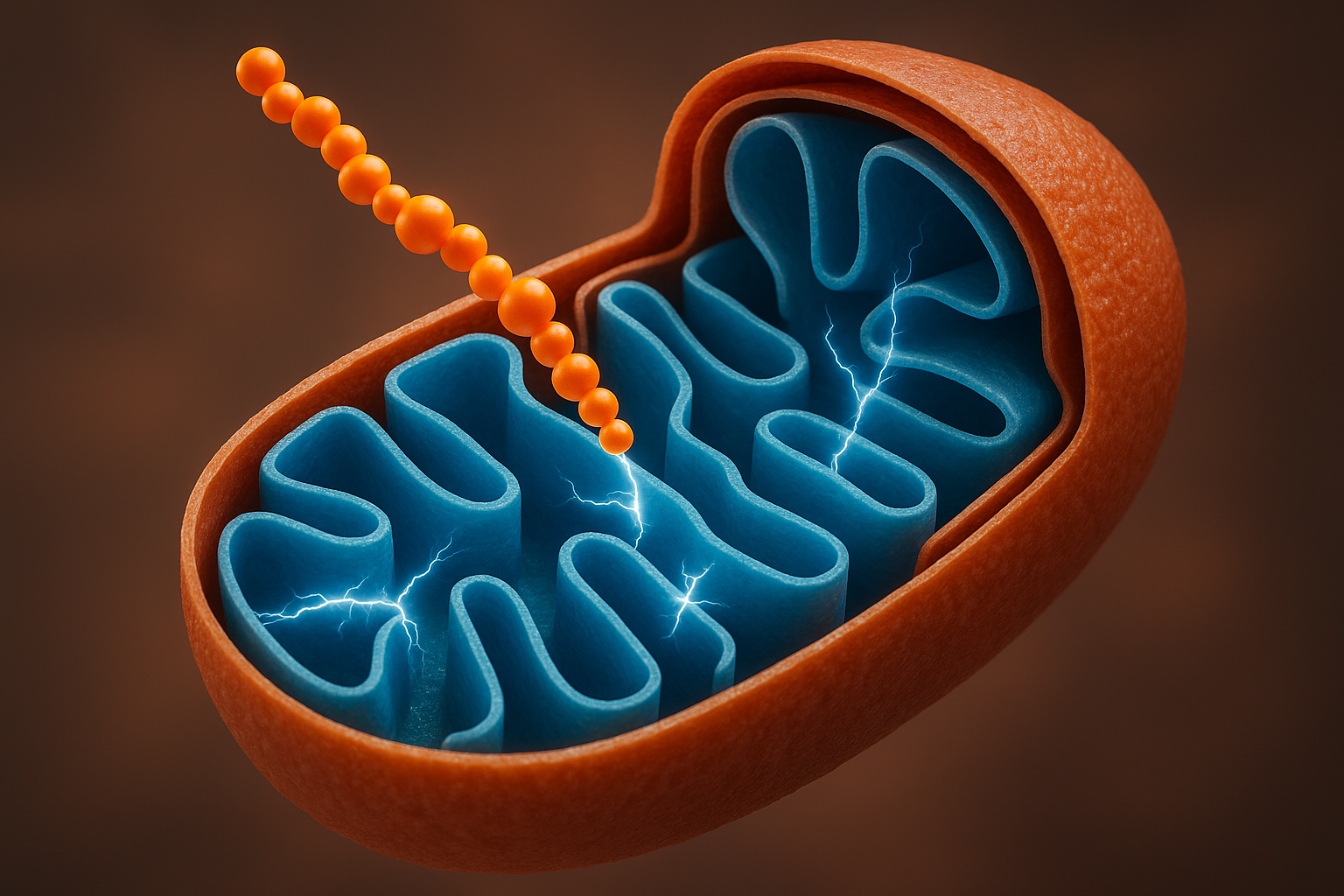
SS-31 (Elamipretide): The Mitochondrial Peptide Targeting Cellular Energy
A synthetic tetrapeptide that crosses cell membranes, binds cardiolipin on the inner mitochondrial membrane, and restores the machinery that produces 90% of your body's ATP. FDA-approved for Barth syndrome. Under investigation for heart failure and aging.
(Daltons)
(Barth Syndrome)
Concentration
Half-Life
Most peptides work on hormones, receptors, or signaling pathways outside the cell. SS-31 goes somewhere different.
It crosses the cell membrane and parks itself on the inner mitochondrial membrane, right where your cells generate energy. That makes it one of the most unusual peptides in clinical development.
This is an educational breakdown of SS-31 (elamipretide), covering its mechanism of action, clinical trials, dosing protocols, and safety profile. It is not a recommendation to use SS-31. Consult a qualified healthcare provider before considering any peptide regimen.
SS-31 at a Glance
SS-31 / Elamipretide
Sequence: D-Arg-Dmt-Lys-Phe-NH2 | Type: Synthetic tetrapeptide (4 amino acids) | Molecular Weight: ~640 Da | Other Names: Elamipretide, Bendavia, MTP-131, Stelanir | Primary Target: Cardiolipin on inner mitochondrial membrane | Route: Subcutaneous injection | FDA Status: Approved for Barth syndrome (2024)
Unlike most peptides that bind extracellular receptors, SS-31 is cell-permeable. It concentrates inside mitochondria at roughly 1,000 to 5,000 times the extracellular concentration within minutes of administration.
For a deeper compound profile, visit PeptideArc.
How SS-31 Works
The mechanism is specific and well-characterized. SS-31 doesn't just "support mitochondrial health" in some vague way. It binds a single target with measurable downstream effects.
Cardiolipin Binding: The Core Mechanism
Cardiolipin is a phospholipid found almost exclusively on the inner mitochondrial membrane. It's essential for the electron transport chain, the process that generates roughly 90% of your body's ATP.
SS-31 binds directly to cardiolipin through electrostatic and hydrophobic interactions (Birk et al., 2013).
What Cardiolipin Does
Required for proper assembly of electron transport chain supercomplexes. Anchors cytochrome c. Maintains the proton gradient that drives ATP synthase. Involved in mitochondrial fission, fusion, and protein import.
What SS-31 Does to It
Stabilizes cristae structure. Optimizes electron transport through complexes I, III, and IV. Reduces electron leak that forms damaging reactive oxygen species. Prevents cardiolipin peroxidation.
Why Cardiolipin Matters
Cardiolipin isn't just another membrane component. It's structurally unique, with four fatty acid chains instead of the usual two.
| Function | Role of Cardiolipin |
|---|---|
| ATP production | Required for proper assembly of ETC supercomplexes |
| Apoptosis | Anchors cytochrome c; oxidized cardiolipin releases it, triggering cell death |
| Mitochondrial dynamics | Involved in fission and fusion of mitochondria |
| Protein import | Facilitates transport of proteins into the mitochondrial matrix |
| Membrane potential | Maintains the proton gradient that drives ATP synthase |
When cardiolipin becomes oxidized or depleted, mitochondria start failing. This happens in aging, heart failure, neurodegenerative disease, and genetic conditions like Barth syndrome.
Age-related decline in cardiolipin content correlates directly with reduced mitochondrial function in heart, brain, and skeletal muscle tissue (Paradies et al., 2010).
Reducing Oxidative Stress (Without Being an Antioxidant)
This distinction matters. SS-31 is not a traditional antioxidant that scavenges free radicals after they form. Instead, it prevents excess ROS from being generated in the first place by keeping the electron transport chain running efficiently.
Think of it like fixing a leaky pipe rather than mopping up the water (Szeto, 2014).
Not a Scavenger, a Stabilizer
Reduces mitochondrial ROS production by up to 45% in preclinical models. Does not affect normal ROS signaling (important because some ROS serve as cellular signals). Protects against ischemia-reperfusion injury, the damage that occurs when blood flow returns after a blockage.
Barth Syndrome: The FDA-Approved Indication
Barth syndrome is a rare genetic disorder caused by mutations in the tafazzin (TAFAZZIN) gene. This gene encodes the enzyme responsible for remodeling cardiolipin into its mature form.
Without functional tafazzin, cardiolipin accumulates in abnormal forms. The result is severe mitochondrial dysfunction, primarily affecting the heart and skeletal muscle.
Prevalence
Pattern
Daily Dose
Improvement
The TAZPOWER Trial
This was the pivotal trial that led to FDA approval.
| Parameter | Detail |
|---|---|
| Participants | 12 patients with genetically confirmed Barth syndrome |
| Design | Randomized, double-blind, placebo-controlled crossover |
| Duration | 12 weeks per treatment period |
| Dose | 40 mg subcutaneous daily |
| Primary endpoint | 6-minute walk test (6MWT) |
| Outcome | Elamipretide | Placebo |
|---|---|---|
| 6MWT improvement | +20.6 meters | -8.6 meters |
| Total distance walked | Significant improvement | No change |
| Patient-reported fatigue | Improved | No change |
The difference between drug and placebo was 29.2 meters on the 6-minute walk test. In a disease this severe, that's clinically meaningful (Thompson et al., 2021).
The FDA granted approval in January 2024 under the brand name Stelanir, making elamipretide the first and only approved treatment specifically targeting the underlying mitochondrial dysfunction in Barth syndrome.
Heart Failure Research
Heart failure is, at its core, an energy crisis. The failing heart can't produce enough ATP to pump effectively. Since SS-31 targets mitochondrial energy production, it was a logical candidate.
EMBRACE Trial (HFrEF)
The largest heart failure trial for elamipretide enrolled 71 patients with heart failure and reduced ejection fraction.
| Endpoint | 4 mg | 40 mg | Placebo |
|---|---|---|---|
| LV end-systolic volume | Improved | Improved | No change |
| Ejection fraction | Trend toward improvement | Trend toward improvement | No change |
| 6MWT | No significant change | No significant change | No change |
The results were mixed. Cardiac imaging showed structural improvements, but functional measures like the walk test didn't hit statistical significance (Butler et al., 2020).
Short treatment duration (4 weeks may not reverse years of cardiac remodeling), small sample size (underpowered for modest effects), and patient heterogeneity (heart failure has many subtypes) all likely contributed.
Post-hoc analyses suggested elamipretide was most effective in patients with the worst baseline mitochondrial function, hinting that patient selection could be critical for future trials.
Ischemia-Reperfusion Injury
When a blocked artery is reopened (as in a heart attack or bypass surgery), the sudden return of oxygenated blood paradoxically causes additional damage.
Preclinical studies showed SS-31 reduced infarct size by 50–60% when administered before reperfusion in animal models (Kloner et al., 2012). Human trials for this indication have been limited and results have not matched the dramatic preclinical findings.
Aging and Exercise Applications
This is where SS-31 research gets particularly interesting for the longevity community. Mitochondrial dysfunction is one of the hallmarks of aging, and SS-31 directly targets it.
Age-Related Mitochondrial Decline
What Goes Wrong With Age
Cardiolipin content decreases. ROS production increases, creating a vicious cycle of oxidative damage. Mitochondrial DNA mutations accumulate. Damaged mitochondria aren't cleared efficiently (impaired mitophagy).
What SS-31 Addresses
Directly protects and stabilizes cardiolipin. Reduces excess ROS production at the source. These are the first two problems on the list, and they're the ones that cascade into everything else.
Preclinical Aging Data
The animal data is striking.
| Study | Model | Key Finding |
|---|---|---|
| Siegel et al., 2013 | Aged mice (26 months) | 8 weeks reversed skeletal muscle mitochondrial decline |
| Campbell et al., 2019 | Aged mice | Restored cardiac diastolic function to near-young levels |
| Sweetwyne et al., 2017 | Aged mice (24 months) | Reversed kidney mitochondrial changes within 8 weeks |
Sources: Siegel et al., 2013, Campbell et al., 2019, Sweetwyne et al., 2017.
In aged mice, 8 weeks of SS-31 treatment was sufficient to restore skeletal muscle energetics to levels seen in young animals. This was not just slowing decline. It was reversal.
Exercise Performance
In aged animals, SS-31 improved exercise tolerance, likely through enhanced mitochondrial ATP production in skeletal muscle. The peptide also reduced exercise-induced oxidative damage.
Aerobic Capacity
More efficient oxidative phosphorylation could mean higher VO2 output.
Recovery
Reduced exercise-induced mitochondrial damage may speed recovery between sessions.
Fatigue Resistance
Better ATP production in endurance activities could delay exhaustion.
No controlled human trials have examined SS-31 specifically for exercise performance in healthy individuals. These remain speculative applications.
Dosing Protocols
These are research-based protocols, not medical prescriptions. The only approved dosing is for Barth syndrome under medical supervision. Always work with a qualified provider.
| Parameter | Detail |
|---|---|
| Approved dose (Barth syndrome) | 40 mg subcutaneous daily |
| Research doses (heart failure) | 4 mg or 40 mg subcutaneous daily |
| Research doses (other) | 0.01 to 0.25 mg/kg in various trials |
| Route | Subcutaneous injection |
| Half-life | Approximately 3–4 hours |
| Frequency | Once daily in most protocols |
Reconstitution
SS-31 from research suppliers typically comes as a lyophilized powder. Standard reconstitution with bacteriostatic water applies.
Practical Notes
The short half-life is worth noting. Unlike peptides such as BPC-157 or semaglutide that are dosed less frequently, SS-31 appears to require daily administration for sustained mitochondrial effects.
Some research protocols have used twice-daily dosing to maintain more consistent tissue concentrations.
Side Effects and Safety
SS-31 has a generally favorable safety profile based on clinical trial data across multiple indications.
| Side Effect | Frequency | Notes |
|---|---|---|
| Injection site reactions | Very common (~30%) | Redness, pain, itching at injection site |
| Headache | Common | Usually mild and transient |
| Fatigue | Occasional | Paradoxical given the mechanism; typically resolves |
| Nausea | Occasional | Less common than with GLP-1 peptides |
| Dizziness | Uncommon | More reported at higher doses |
| Skin reactions | Uncommon | Rash or urticaria in some patients |
| Contact urticaria | Rare | Reported in Barth syndrome trials |
Severe injection site reactions (spreading redness, swelling, signs of infection), allergic reactions (difficulty breathing, facial swelling, widespread hives), or persistent worsening of symptoms. Consult your provider immediately.
For a broader overview, see our peptide side effects guide.
SS-31 vs. MOTS-c: Two Approaches to Mitochondrial Health
Both SS-31 and MOTS-c are called "mitochondrial peptides," but they work through completely different mechanisms.
| Feature | SS-31 (Elamipretide) | MOTS-c |
|---|---|---|
| Origin | Synthetic (lab-designed) | Endogenous (mitochondrial DNA) |
| Target | Cardiolipin on inner membrane | AMPK pathway, nuclear gene regulation |
| Mechanism | Stabilizes electron transport chain | Activates cellular energy sensor |
| Primary effects | Restores structure & ATP production | Metabolic regulation, insulin sensitivity |
| Clinical trials | Multiple phase 2/3, one FDA approval | Very early development |
| FDA status | Approved (Barth syndrome) | Not approved |
| Best studied for | Heart failure, genetic mitochondrial disease | Metabolic syndrome, obesity, exercise |
| Half-life | ~3–4 hours | Not well characterized in humans |
SS-31 works from the inside out, physically stabilizing the machinery that makes ATP. MOTS-c works from the outside in, activating signaling pathways that tell cells to ramp up energy metabolism. They're complementary rather than competing approaches.
For structural mitochondrial damage (aging, genetic disease, ischemia), SS-31 has stronger evidence. For metabolic dysfunction and insulin resistance, MOTS-c may be more relevant.
Who Might Benefit
Barth Syndrome Patients
The only FDA-approved indication. Demonstrated clinical benefit in a controlled trial.
Mitochondrial Myopathies
Conditions where impaired mitochondrial function drives muscle weakness.
Heart Failure Patients
Particularly those with evidence of mitochondrial dysfunction as a primary driver.
Aging Adults
Strong animal data showing reversal of age-related mitochondrial changes. No human aging trials yet.
Outside of Barth syndrome, all applications are investigational. Clinical evidence in healthy aging adults does not yet exist.
Legal Status and Availability
United States
FDA-approved for Barth syndrome (Stelanir). Investigational for all other uses.
European Union
Not approved. Orphan drug designation granted.
Australia
Not approved. Available through special access schemes.
Research Use
Available from peptide research suppliers. Quality and purity vary.
The Barth syndrome approval does not make SS-31 legally available for off-label use without a prescription. Check our peptide legality guide for full details.
Frequently Asked Questions
What does SS-31 actually do?
How quickly does SS-31 work?
Is SS-31 the same as elamipretide?
Can SS-31 reverse aging?
Can I combine SS-31 with other peptides?
How is SS-31 different from CoQ10 or other mitochondrial supplements?
What does SS-31 treatment cost?
Does SS-31 need to be cycled?
The Bottom Line
SS-31 is one of the most precisely targeted peptides in existence. Rather than working through hormone receptors or broad signaling pathways, it goes directly to the inner mitochondrial membrane and stabilizes the machinery that produces cellular energy.
The FDA approval for Barth syndrome validated the mechanism. The heart failure data, while mixed, showed biological activity in the right direction. And the preclinical aging data is some of the most compelling evidence for any single intervention targeting mitochondrial decline.
The big question is whether the striking animal results will translate to meaningful benefits in aging humans. That data doesn't exist yet. But for a peptide that targets one of the most fundamental processes in cellular biology, SS-31 is worth watching closely.
This article is for educational and informational purposes only. It is not medical advice and should not be treated as such. SS-31 (elamipretide) is FDA-approved only for Barth syndrome under the brand name Stelanir. All other uses discussed in this article are investigational. Always consult a qualified healthcare provider before starting any peptide protocol. Never self-administer any compound without proper medical supervision.
References
Birk AV, et al. The mitochondria-targeted compound SS-31 re-energizes ischemic mitochondria by interacting with cardiolipin. J Am Soc Nephrol. 2013;24(8):1250–1261. PubMed
Paradies G, et al. Role of cardiolipin peroxidation and cytochrome c release in the decline of mitochondrial function in aging. Free Radic Biol Med. 2010;48(10):1286–1295. PubMed
Szeto HH. First-in-class cardiolipin-protective compound as a therapeutic agent to restore mitochondrial bioenergetics. Br J Pharmacol. 2014;171(8):2029–2050. PubMed
Thompson R, et al. Elamipretide in patients with Barth syndrome: a randomized, double-blind, placebo-controlled clinical trial followed by open-label extension. Genet Med. 2021;23(12):2364–2371. PubMed
Butler J, et al. Effects of elamipretide on left ventricular function in patients with heart failure with reduced ejection fraction: the EMBRACE trial. Eur J Heart Fail. 2020;22(3):431–441. PubMed
Kloner RA, et al. Reduction of ischemia/reperfusion injury with bendavia, a mitochondria-targeting cytoprotective peptide. J Am Heart Assoc. 2012;1(3):e001644. PubMed
Siegel MP, et al. Mitochondrial-targeted peptide rapidly improves mitochondrial energetics and skeletal muscle performance in aged mice. Aging Cell. 2013;12(5):763–771. PubMed
Campbell MD, et al. Improving mitochondrial function with SS-31 reverses age-related redox stress and improves exercise tolerance in aged mice. Free Radic Biol Med. 2019;134:268–281. PubMed
Sweetwyne MT, et al. The mitochondrial-targeted peptide, SS-31, improves glomerular architecture in mice of advanced age. Kidney Int. 2017;91(5):1126–1145. PubMed
Related reading:
What Are Peptides? Beginner's Guide · Peptide Side Effects: What to Know · Are Peptides Legal? FDA Regulations 2026 · MOTS-c Mitochondrial Peptide Guide
For compound profiles and sourcing info, visit PeptideArc.