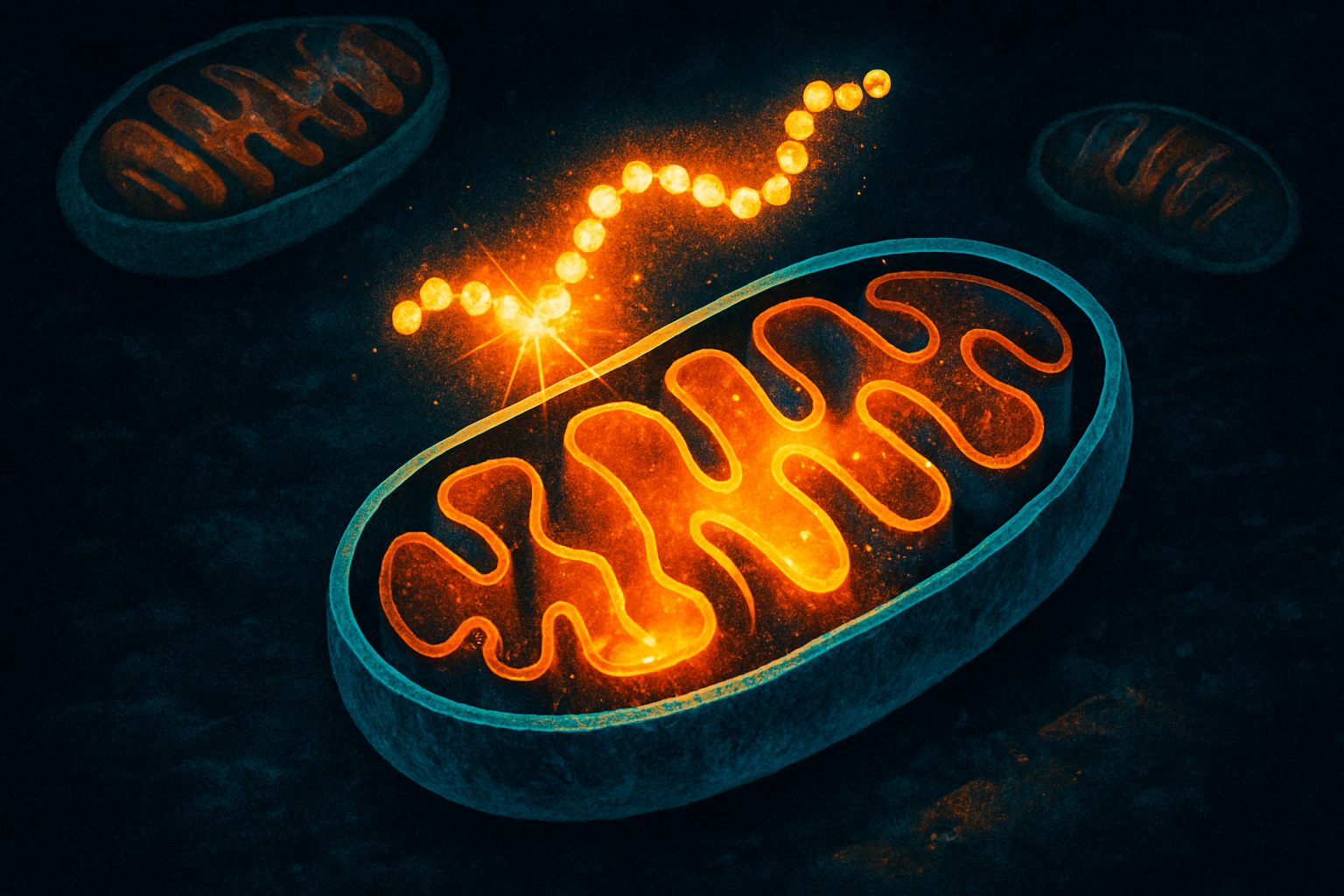
MOTS-c: The Mitochondrial Peptide for Metabolism and Longevity
A 16-amino-acid peptide encoded by mitochondrial DNA that activates AMPK, mimics exercise pathways, and declines with age. What the research shows about metabolism, physical performance, and aging.
Length
Mechanism
Year (USC)
Mitochondrial Genome
Your mitochondria have their own genome. It's tiny compared to nuclear DNA, but it encodes some genuinely interesting molecules.
In 2015, researchers at USC discovered that one of those molecules might be a key player in metabolism, aging, and exercise physiology. That molecule is MOTS-c (Lee et al., 2015).
This is an educational breakdown of MOTS-c, covering its mechanisms, research findings, dosing protocols, and safety profile. It is not a recommendation to use MOTS-c. MOTS-c is not FDA-approved for any medical indication. Consult a qualified healthcare provider before considering any peptide regimen.
MOTS-c at a Glance
MOTS-c (Mitochondrial-Derived Peptide)
Full Name: Mitochondrial Open Reading Frame of the Twelve S rRNA type-c | Sequence: MRWQEMGYIFYPRKLR | Length: 16 amino acids | Origin: Mitochondrial genome (12S rRNA) | Discovered: 2015, USC (Lee et al.) | Primary Mechanism: AMPK activation | Related Peptides: Humanin, SHLPs | FDA Status: Not approved for any indication
MOTS-c belongs to a growing family of mitochondrial-derived peptides (MDPs) that includes humanin and SHLPs. These molecules challenge the old view of mitochondria as simple energy factories.
Mitochondria are active signaling organelles. They communicate with the rest of the cell and with distant tissues through peptides like MOTS-c, which circulates in the blood and can be detected across multiple organ systems.
For a deeper compound profile, visit PeptideArc.
How MOTS-c Works: Three Core Mechanisms
MOTS-c acts through several interconnected pathways. Understanding these mechanisms explains why researchers have called it an "exercise mimetic" and why its decline with age matters for longevity.
AMPK Activation
The centerpiece of MOTS-c's mechanism is activation of AMPK (AMP-activated protein kinase). This enzyme is often called the body's "metabolic master switch."
The original Lee et al. study showed that MOTS-c treatment in mice activated AMPK in skeletal muscle. This led to increased glucose uptake and improved metabolic function, even in mice on a high-fat diet (Lee et al., 2015).
| AMPK Effect | What Happens | Relevance |
|---|---|---|
| Glucose uptake | Muscles pull more sugar from the blood | Metabolic health |
| Fatty acid oxidation | Body burns more fat for fuel | Body composition |
| Mitochondrial biogenesis | Cells build more energy factories | Cellular energy |
| Lipogenesis inhibition | Less new fat creation | Anti-obesity |
If that sounds like what exercise does to your body, you're not wrong. That's exactly why MOTS-c has been called an "exercise mimetic."
Folate-Methionine Cycle Regulation
MOTS-c inhibits the folate cycle, leading to accumulation of a metabolite called AICAR. AICAR is itself an AMPK activator, creating a positive feedback loop that amplifies the metabolic effects.
This connects MOTS-c to one-carbon metabolism, which plays roles in DNA synthesis, methylation, and cellular energy balance.
Nuclear Translocation
A 2019 study made a surprising discovery. MOTS-c can translocate from the mitochondria to the nucleus in response to metabolic stress (Kim et al., 2019).
Once in the nucleus, it interacts with nuclear DNA to regulate gene expression related to stress response and metabolism. A peptide encoded by mitochondrial DNA that physically moves to the nucleus and alters nuclear gene expression represents a direct communication channel between the two genomes.
Scientists call this "mitonuclear communication." It challenges the old model where mitochondria were passive energy generators. They're active participants in cellular decision-making.
The "Exercise Mimetic" Effect
This is probably the most attention-grabbing aspect of MOTS-c research. Exercise itself increases circulating MOTS-c levels in humans. Young healthy men who underwent acute exercise bouts had significantly elevated plasma MOTS-c compared to rest (Reynolds et al., 2021).
But let's be clear about what "exercise mimetic" actually means.
| Benefit | MOTS-c | Exercise |
|---|---|---|
| Glucose metabolism | Yes | Yes |
| Fat accumulation | Reduced | Reduced |
| Insulin sensitivity | Improved | Improved |
| Mitochondrial function | Enhanced | Enhanced |
| Cardiovascular conditioning | No | Yes |
| Musculoskeletal loading | No | Yes |
| Neurological benefits | Limited | Yes |
| Psychological effects | No | Yes |
Think of MOTS-c as a metabolic booster that works through similar channels as exercise. It is not a replacement for it.
The most interesting application might be combining MOTS-c with exercise to amplify the metabolic benefits.
MOTS-c for Metabolic Health
Obesity and Weight Management
In mouse models, MOTS-c consistently shows anti-obesity effects. It prevents diet-induced obesity and improves metabolic markers in already obese animals. The mechanism involves both increased energy expenditure and improved fuel use, not appetite suppression.
Type 2 Diabetes
Circulating MOTS-c is significantly lower in individuals with type 2 diabetes compared to healthy controls (Ramanjaneya et al., 2019). This correlation doesn't prove causation, but it adds to the picture that MOTS-c deficiency may contribute to metabolic dysfunction.
Insulin Signaling
MOTS-c improves insulin sensitivity through multiple mechanisms. By activating AMPK and increasing glucose uptake in muscle tissue, it mimics some of the metabolic benefits of exercise on insulin sensitivity.
Studies in obese mice showed MOTS-c treatment improved glucose tolerance and reduced insulin resistance (Lee et al., 2015).
The combination of insulin resistance, central obesity, dyslipidemia, and hypertension that constitutes metabolic syndrome aligns with the pathways MOTS-c influences. By targeting AMPK and improving metabolic flexibility, MOTS-c could theoretically address multiple components at once. But human clinical trials are still in early stages.
MOTS-c and Longevity
The longevity angle is what separates MOTS-c from most metabolic peptides. Multiple lines of evidence connect it directly to aging biology.
Age-Related Decline
MOTS-c levels decline with age in both animal and human studies. Given that the peptide improves metabolic function, protects against insulin resistance, and enhances stress resilience, this decline could contribute to the metabolic deterioration associated with aging.
Physical Function in Aging
A striking 2020 study showed that MOTS-c treatment improved physical performance in old mice. Aged mice treated with MOTS-c showed improved running endurance, better grip strength, and enhanced metabolic function (Reynolds et al., 2021).
The treated mice performed like younger animals on several physical measures.
Centenarian Genetics
The Centenarian MOTS-c Variant
A genetic variant (m.1382A>C) in the MOTS-c gene region produces K14Q MOTS-c with potentially enhanced activity. This variant was found to be more common in Japanese centenarians (Fuku et al., 2015). It's exactly the kind of evidence that links laboratory findings to real-world longevity outcomes.
| Finding | Detail | Significance |
|---|---|---|
| Variant | m.1382A>C in MOTS-c gene region | Identified in mtDNA |
| Population | Japanese centenarians | Real-world validation |
| Effect | Produces K14Q MOTS-c | Potentially enhanced activity |
| Implication | Connects lab to longevity | Translational promise |
Cellular Stress Resistance
MOTS-c enhances the cell's ability to handle metabolic stress through AMPK activation and nuclear gene expression changes. It primes cells to deal with the kinds of metabolic challenges that increase with age.
This connects to broader concepts like hormesis and metabolic flexibility, both central themes in longevity research.
Dosing Protocols
MOTS-c is still in the research phase. Dosing comes primarily from animal studies and the emerging practitioner community. The original mouse studies used 5 mg/kg intraperitoneally, which doesn't translate directly to human dosing.
| Parameter | Standard Protocol | Alternative Protocol |
|---|---|---|
| Dose | 5–10 mg per injection | 5 mg daily |
| Frequency | 2–3 times per week | Daily |
| Route | Subcutaneous injection | Subcutaneous injection |
| Cycle length | 4–8 weeks | 2–4 weeks |
The practitioner community has settled on these ranges based on early clinical experience, but they should be considered provisional.
Some practitioners recommend administering MOTS-c before exercise to amplify the metabolic response. Others use it on rest days. There's no definitive research on optimal timing in humans.
MOTS-c is administered by injection because, like most peptides, it would be degraded by digestive enzymes if taken orally. For injection technique, see our subcutaneous injection guide. The peptide is typically supplied as a lyophilized powder reconstituted with bacteriostatic water.
Need help with dosing math? Use our free Peptide Reconstitution Calculator.
Side Effects and Safety
The safety profile of MOTS-c in humans is not well-established through formal clinical trials. Here's what's been reported so far.
| Side Effect | Frequency | Severity |
|---|---|---|
| Injection site reactions | Common | Mild |
| Transient flushing/warmth | Occasional | Mild |
| Hypoglycemia-like symptoms | Rare | Mild to moderate |
| Fatigue or energy changes | Occasional | Mild, transient |
Not Observed
No significant organ toxicity in animal studies. No major hormonal disruptions. No immune suppression reported.
Caution Groups
Those with hypoglycemia or on blood sugar-lowering medications. Individuals with very low body fat. Pregnant or breastfeeding women.
Cancer Consideration
Anyone with active cancer should exercise extra caution. AMPK activation has complex and sometimes contradictory effects on cancer biology.
Where to Get MOTS-c
As of early 2026, MOTS-c is not FDA-approved for any medical indication.
| Source | Quality | Access |
|---|---|---|
| Research chemical suppliers | Variable (require COAs) | Most common source |
| Compounding pharmacies | Better quality assurance | Requires prescription |
| Clinical trials | Highest quality | Limited enrollment |
The cost is relatively high compared to many other research peptides, reflecting both synthesis complexity and growing demand.
Stacking MOTS-c
No formal interaction studies exist. Introduce one compound at a time and give each at least 2–3 weeks before adding another.
| Stack | Goal | Rationale |
|---|---|---|
| MOTS-c + Tesamorelin/Ipamorelin | Body composition | Complementary metabolic and GH pathways |
| MOTS-c + NAD+ precursors | Mitochondrial support | Dual approach to mitochondrial health |
| MOTS-c + Methylene blue | Electron chain support | Theoretical synergy |
| MOTS-c + BPC-157 | Metabolism + tissue repair | Different mechanisms, no overlap |
MOTS-c vs. Humanin
They're siblings from the same mitochondrial genome, but with different jobs.
| Feature | MOTS-c | Humanin |
|---|---|---|
| Primary focus | Metabolism, insulin sensitivity | Cytoprotection, anti-apoptosis |
| Main research area | Obesity, exercise, aging | Alzheimer's, neuroprotection |
| Key mechanism | AMPK activation | Anti-apoptotic signaling |
| Origin | Mitochondrial genome | Mitochondrial genome |
Frequently Asked Questions
Is MOTS-c natural or synthetic?
Can MOTS-c replace exercise?
How long does it take to see results?
Will MOTS-c help me lose weight?
What's the connection between MOTS-c and aging?
How should I store MOTS-c?
Is MOTS-c legal?
Can I take MOTS-c orally?
The Bottom Line
MOTS-c is one of the most scientifically interesting peptides to emerge in the past decade. The discovery that mitochondria produce signaling peptides regulating whole-body metabolism has opened an entirely new area of biology. The early data on metabolism, insulin sensitivity, and physical performance in aging is genuinely compelling.
But most of the data is from mice. Human clinical trials are in early stages. Dosing protocols are extrapolated from animal studies and clinical intuition, not controlled dose-finding studies.
If you're interested in MOTS-c, view it as a promising but still experimental tool. Use it under medical supervision if possible. Combine it with the fundamentals: exercise, good nutrition, adequate sleep, and stress management.
The mitochondria have been trying to tell us something. We're just now learning to listen.
This article is for educational and informational purposes only. It is not medical advice and should not be treated as such. MOTS-c is not FDA-approved for any medical indication. Always consult a qualified healthcare provider before starting any peptide protocol. Individual results vary. The research cited here is primarily from animal studies and early human observations.
References
Lee C, Zeng J, Drew BG, et al. The mitochondrial-derived peptide MOTS-c promotes metabolic homeostasis and reduces obesity and insulin resistance. Cell Metab. 2015;21(3):443–454. PubMed
Kim KH, Son JM, Benayoun BA, Lee C. The mitochondrial-encoded peptide MOTS-c translocates to the nucleus to regulate nuclear gene expression in response to metabolic stress. Cell Metab. 2018;28(3):516–524. PubMed
Reynolds JC, Lai RW, Woodhead JST, et al. MOTS-c is an exercise-induced mitochondrial-encoded regulator of age-dependent physical decline and muscle homeostasis. Nat Commun. 2021;12(1):470. PubMed
Ramanjaneya M, Joshi S, Darker JG, et al. Lipids, apolipoproteins, and inflammatory biomarkers significantly correlate with MOTS-c in type 2 diabetes. Diabetes Metab Res Rev. 2019;35(5):e3171. PubMed
Fuku N, Pareja-Galeano H, Zempo H, et al. The mitochondrial-derived peptide MOTS-c: a player in exceptional longevity? Aging Cell. 2015;14(6):921–923. PubMed
Related reading:
SS-31 (Elamipretide) Mitochondrial Guide · Epithalon Anti-Aging Guide · BPC-157 Complete Guide · Tesamorelin/Ipamorelin Stack Guide
For compound profiles and sourcing info, visit PeptideArc.