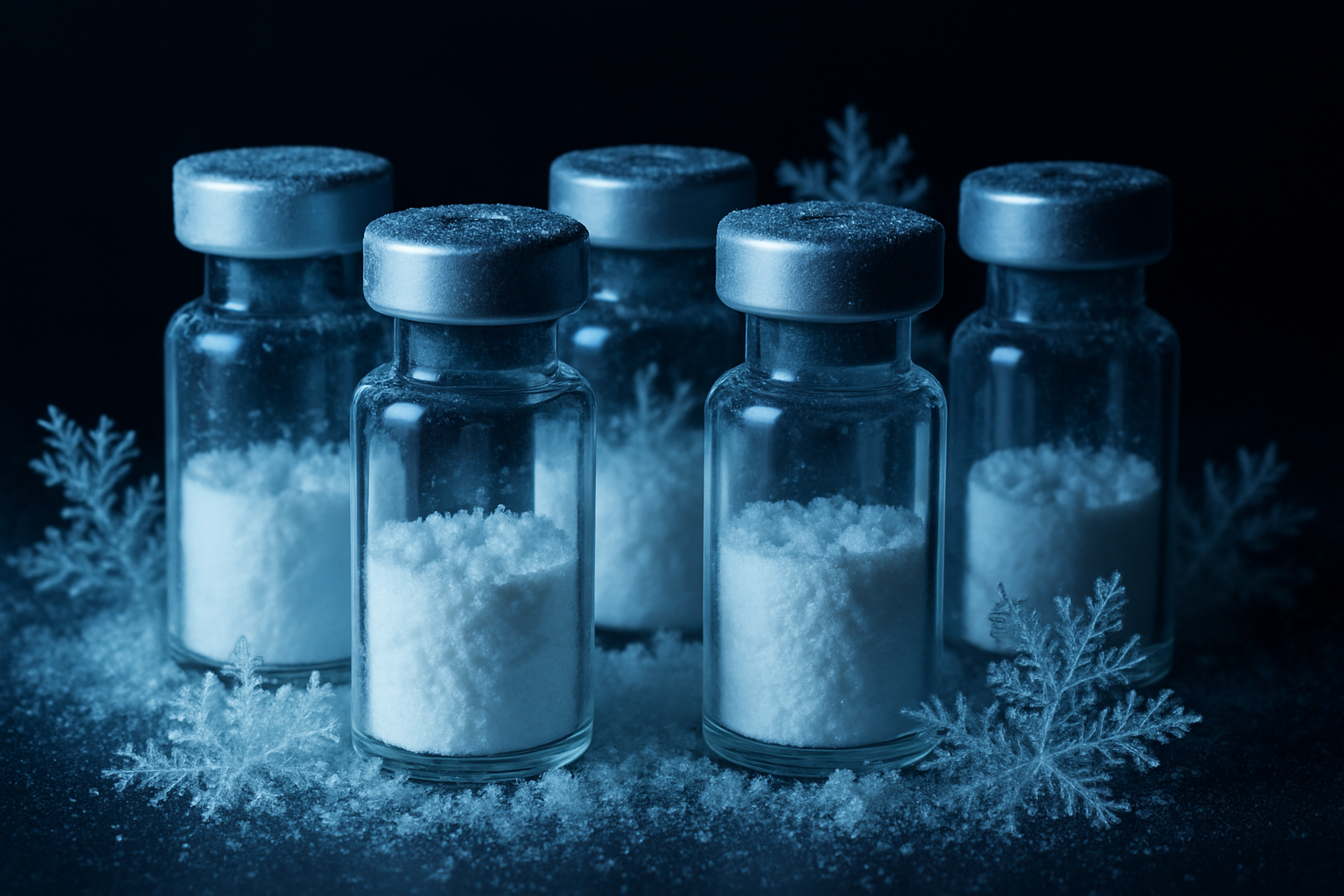
How to Store Peptides: Lyophilized and Reconstituted
Peptide stability comes down to three things: heat, light, and contamination. Control those, and storage is straightforward. Practical rules for both powder and liquid forms.
Freezer Storage
Fridge Range
Shelf Life (BAC)
Shelf Life
Most peptide failures happen before anyone draws the first dose. Vials left on a counter too long, powder exposed to humidity, a reconstituted solution stored without preservative for weeks. These are preventable problems.
This guide covers storage rules for both lyophilized (powder) and reconstituted (liquid) peptides. If you need the mixing steps first, start with how to reconstitute peptides.
Lyophilized powders are far more stable than liquids. For long-term storage, a freezer around -20°C is the default. Once reconstituted, most peptides belong in the fridge (2 to 8°C). If anything looks off, cloudiness, particles, or color change, assume it is not usable.
Storage Quick Reference
| State | Best Temperature | Light | Typical Shelf Life |
|---|---|---|---|
| Lyophilized (powder, sealed) | Freezer (-20°C) | Dark | Months to years |
| Reconstituted with BAC water | Fridge (2 to 8°C) | Dark | ~3 to 4 weeks |
| Reconstituted with sterile water | Fridge (2 to 8°C) | Dark | ~48 to 72 hours |
These are practical ranges, not guarantees. Different peptides and formulations degrade at different rates. Compound-specific stability data always trumps general advice.
Lyophilized vs Reconstituted: What Changes
Lyophilized peptides are freeze-dried powders. Because water is removed, the common degradation pathways (hydrolysis, deamidation, oxidation) slow down dramatically. Reconstituted peptides have water in the vial, and that water reactivates both chemical change and microbial risk from repeated punctures.
If you only remember one idea from this page, remember this. Powder buys you time. Liquid does not.
How to Store Lyophilized Peptides (Powder)
Temperature
A freezer around -20°C is the standard long-term choice. A fridge (2 to 8°C) works for shorter storage when you plan to reconstitute soon.
Light
Many peptides are UV-sensitive. Keep vials in original packaging or an opaque container. This alone prevents a common source of potency loss.
Moisture
Humidity is the quiet problem for powders. Keep vials sealed until reconstitution and store with a desiccant pack when possible.
Freezer vs Fridge for Lyophilized Storage
A freezer at -20°C is the gold standard for long-term storage. A refrigerator (2 to 8°C) is acceptable for vials you plan to use within a few weeks. Avoid leaving lyophilized peptides at room temperature for extended periods. Short handling time during reconstitution is fine, but steady warmth accelerates degradation of the peptide bond structure.
Research on pharmaceutical peptide stability confirms that lower temperatures consistently slow degradation kinetics across peptide classes (PubMed: 30767404). The relationship is not linear. Going from room temperature to fridge temperature helps a lot. Going from fridge to freezer helps more, but the biggest jump is getting below ambient.
Opening vials "just to check" exposes the powder to humidity. Minimize how long the vial is open to air. Every second counts more than you think in a humid environment.
Light Exposure and Photodegradation
UV and bright visible light can trigger photodegradation in many peptide sequences. Tryptophan-containing peptides are especially vulnerable. A general review of photodegradation in pharmaceuticals covers the mechanisms in detail (PubMed: 26055427).
The fix is simple. Keep vials in their box or in an opaque container. If you use a clear storage bin in your freezer, wrap vials in foil or put them inside a small opaque bag.
How to Store Reconstituted Peptides (Liquid)
Once a peptide is reconstituted, treat it like a perishable lab reagent. Keep it cold, keep it clean, and keep exposure time short.
Bacteriostatic Water vs Sterile Water
| Factor | Bacteriostatic Water | Sterile Water |
|---|---|---|
| Preservative | Yes (0.9% benzyl alcohol) | No |
| Multi-dose use | More suitable | Higher contamination risk |
| Practical shelf life (fridge) | Often weeks | Often days |
| Cost per vial | Slightly higher | Lower |
| Sensitivity concerns | Rare benzyl alcohol allergy | None |
Bacteriostatic water contains a preservative (typically 0.9% benzyl alcohol) that inhibits microbial growth when you puncture the vial multiple times. Sterile water has no preservative. It can be appropriate for single-use draws, but it raises the contamination risk significantly for multi-dose vials.
Repeated vial access is a well-documented contamination pathway in clinical settings (PubMed: 22610028). This is why most people prefer bacteriostatic water for any vial they plan to draw from more than once.
Five Habits That Prevent Most Problems
Most failures come from sloppy handling, not mysterious chemical breakdown. 1. Swab the vial stopper with an alcohol pad before every puncture. 2. Use a fresh needle and syringe each time. 3. Inject diluent slowly down the vial wall during reconstitution. 4. Mix gently by rolling or slow inversion, never shake. 5. Return the vial to the fridge within 60 seconds of drawing your dose.
Should You Freeze Reconstituted Peptides?
Freeze-Thaw Cycles Damage Peptides
Freezing a reconstituted vial is controversial because the outcome depends on the specific peptide and its formulation. Freeze-thaw cycles can cause concentration gradients, precipitation, and structural stress. Ice crystal formation physically disrupts tertiary structure in ways that gentle temperature changes do not.
If you are not working from peptide-specific stability data, the safer default is to avoid freezing reconstituted vials entirely. Instead, store your peptides as lyophilized powders in the freezer and only reconstitute what you can reasonably use within the shelf-life window.
Some researchers aliquot reconstituted peptides into single-use portions before freezing, which avoids repeated freeze-thaw cycles. This is a valid approach if you have the right supplies, but it adds complexity and contamination opportunities during the splitting process.
Studies on protein and peptide stability consistently show that freeze-thaw damage is cumulative. Each cycle introduces new opportunities for ice-crystal-induced structural disruption (PubMed: 28688727). If you must freeze, do it once and thaw once.
Setting Up Your Storage Environment
You do not need a lab-grade setup to store peptides properly. A standard household fridge and freezer will handle the job if you follow a few principles.
Fridge Thermometer
A cheap digital thermometer confirms your fridge holds 2 to 8°C consistently. Many household fridges run warmer than their dial suggests, especially older models.
Dedicated Container
A small opaque plastic box keeps vials organized, protected from light, and separate from food items. Label it clearly so household members know not to move it.
Desiccant Packs
Toss a silica gel packet into your lyophilized storage container. Freezers and fridges have humidity, especially when doors open frequently. Desiccants absorb that moisture.
If you live in a hot climate, consider what happens during power outages. A small battery-powered temperature alarm costs under $20 and will alert you if your fridge or freezer warms past a threshold. For high-value peptide collections, this is cheap insurance.
What to Do When the Power Goes Out
Keep the fridge and freezer doors closed. A full freezer holds safe temperatures for about 48 hours if unopened. A half-full freezer holds for about 24 hours. Reconstituted peptides in the fridge are more vulnerable. If the outage lasts more than 4 hours, move reconstituted vials to a cooler with ice packs. Lyophilized powders in a closed freezer will likely be fine.
Signs Something Has Gone Wrong
Visual Red Flags
Cloudiness that was not present after initial reconstitution. Visible particles or "floaters" in the solution. Color changes from the original clear appearance. Any of these suggest aggregation, contamination, or chemical breakdown.
Physical Damage
Cracked glass anywhere on the vial body. Compromised stopper that does not seal properly. Suspected contamination from a dropped vial, unswabbed puncture, or reused needle. If you are injecting, contamination is a bigger risk than potency loss.
When in doubt, discard and replace. A single vial of peptide costs far less than treating an infection from a contaminated injection.
Traveling with Peptides
If you travel with peptides, focus on two things: temperature stability and breakage prevention. Use an insulated case with a cold pack and keep the vial protected from direct light.
Packing Essentials
Insulated case: A small insulin travel cooler works well. Cold packs: Gel packs keep temps stable without freezing. Padding: Wrap vials in bubble wrap or foam. Light protection: Use an opaque case or wrap vials in foil. Alcohol swabs: Bring extras for each planned draw.
For a full walkthrough on TSA rules, international travel, and packing lists, see how to travel with peptides.
Driving Trips
Keep vials in a cooler in the passenger cabin, not the trunk. Trunks can reach extreme temperatures in summer, and even a few hours of heat exposure can compromise reconstituted peptides.
Air Travel
Carry peptides in your carry-on bag. Checked luggage goes through unpressurized, unheated cargo holds. Temperature extremes and rough handling make checked bags a poor choice for glass vials.
Labeling and Organization
When you have more than one vial, the biggest risk becomes mix-ups. Label each vial with the peptide name, the reconstitution date, the concentration, and the solvent used. A fine-tip permanent marker on medical tape works well.
Freezer Organization
Store vials in a small opaque container. That reduces light exposure, prevents breakage, and makes it harder to leave something out on the counter by accident.
Avoid the Door
Door shelves see the biggest temperature swings from opening and closing. Temperature fluctuations are harder on stability than steady cold. Use a back shelf instead.
What to Write on Each Label
Good labeling takes 30 seconds and prevents the most common storage mistake: grabbing the wrong vial. Here is a simple format that covers everything you need.
Minimum Information Per Vial
Line 1: Peptide name (e.g., BPC-157) | Line 2: Concentration after reconstitution (e.g., 250 mcg/tick) | Line 3: Reconstitution date | Line 4: Solvent used (BAC water or sterile water) | Line 5: Discard-by date based on your shelf-life estimate
Five Common Storage Mistakes
Leaving Vials at Room Temp
People set a vial on the counter while they prep, then forget about it. Even 30 minutes of room temperature is fine. Three hours is pushing it for reconstituted peptides. Set a phone timer if you have to.
Using Sterile Water for Multi-Dose Vials
Sterile water is fine for a single draw. But without the preservative in bacteriostatic water, bacteria can multiply between punctures. If you plan more than one draw from a vial, always use BAC water.
Skipping the Alcohol Swab
It takes five seconds. Skipping it introduces skin flora and environmental bacteria directly into your vial. This is the single easiest contamination prevention step you can take.
Shaking Instead of Rolling
Aggressive shaking causes foaming and can physically damage peptide structure through shear stress. Gentle rolling between your palms or slow inversion dissolves the powder without the risk.
Reconstituting Too Much at Once
If a vial contains 5mg and your daily dose is 250mcg, that is 20 doses. At one dose per day, you need 20 days of shelf life. With BAC water in the fridge, that is usually fine. But if you reconstitute five vials at once "for convenience," you will likely waste three of them before you get to them. Reconstitute as you go.
Storage Notes by Peptide Category
Not all peptides are created equal when it comes to storage sensitivity. Some are remarkably hardy. Others start losing potency the moment you look at them wrong.
CJC-1295, Ipamorelin, Tesamorelin, Sermorelin
Growth hormone secretagogues are generally stable when lyophilized at -20°C. Once reconstituted with bacteriostatic water, most users report reliable potency for 3 to 4 weeks in the fridge. Ipamorelin and CJC-1295 are among the more forgiving peptides for storage. Tesamorelin follows similar patterns.
BPC-157, TB-500
BPC-157 is relatively stable in both forms, though light sensitivity means dark storage matters. TB-500 (Thymosin Beta-4) is a larger peptide that can be more prone to aggregation if agitated. Gentle handling during reconstitution is especially important for TB-500.
Semax, Selank, Dihexa
Semax and Selank are often supplied as nasal sprays, which have their own shelf-life considerations. If you reconstitute from powder, follow the same fridge storage rules. Dihexa is typically more stable as a lyophilized powder but can degrade faster once in solution due to its smaller size.
Semaglutide, Tirzepatide
Semaglutide and tirzepatide are GLP-1 receptor agonists with well-documented manufacturer storage guidelines. Prefilled pens should be stored in the fridge and used within the manufacturer's specified window (typically 56 days for semaglutide pens). Do not freeze these once they have been dispensed.
Common Degradation Mechanisms
Understanding why peptides break down helps you prevent it. Four primary pathways account for most peptide degradation in storage.
| Mechanism | Trigger | Prevention | Risk Level |
|---|---|---|---|
| Hydrolysis | Water exposure | Keep lyophilized until use | High in liquid |
| Oxidation | Air, light, metals | Sealed vials, dark storage | Moderate |
| Deamidation | pH shifts, heat | Proper buffer, cold storage | Moderate |
| Aggregation | Freeze-thaw, agitation | Gentle handling, avoid freezing liquid | High if shaken |
| Microbial | Repeated puncture | BAC water, sterile technique | High without BAC |
A comprehensive review of peptide stability in pharmaceutical contexts covers these pathways in detail (PubMed: 25456049). The practical takeaway is that most degradation is preventable with basic storage discipline.
Frequently Asked Questions
How long do lyophilized peptides last?
Can I store peptides in a normal fridge door?
Does shaking a reconstituted peptide ruin it?
Can I store reconstituted peptides in a cooler for a few hours?
What happens if my peptide was left at room temperature overnight?
Is it safe to use a peptide past its expiration date?
The Bottom Line
Treat peptide storage like basic lab hygiene. Keep powders cold and dry, keep reconstituted vials refrigerated, avoid light, and prioritize contamination control above everything else.
If you live in a hot climate or have frequent power outages, think about redundancy. A small temperature alarm in the fridge or freezer and an insulated container for short disruptions can prevent an expensive loss.
When you are unsure about stability for a specific compound, the safest default is to store it lyophilized and only reconstitute what you can use within the expected shelf-life window.
This article is for educational purposes only and is not medical advice. Peptide storage practices described here reflect general guidance from published research and common handling protocols. Always consult a qualified healthcare provider before starting any peptide protocol. PeptideRundown has no affiliation with any peptide vendor.
Related reading: How to Reconstitute Peptides · How to Inject Peptides Subcutaneously · How to Read a Peptide CoA · Peptide Dosing Calculator · Beginner's Guide to Peptides
For compound profiles and sourcing info, visit PeptideArc.